
|
|||||||||||||||
| Book launch Preserving our democratic legacy
by Tengku Razaleigh Hamzah
Please support our work by buying a copy of our print publication, Aliran Monthly, from your nearest news-stand. Better still take out a subscription now. We also welcome donations.
From what we hear from the nation�s grapevine, the general election is just around the corner. At this point in time, this fact alone is sufficient for me to say that Tunku Sofiah�s new book, entitled �Malaysian Election Laws� is indeed one of our country�s most relevant books. Legitimacy of governments Ever since the middle of the last century, there has been tremendous development in the field of governance all over the world. New nations have emerged after freeing themselves from the yoke of colonialism. There were leaders of nations that came to power by force but these did not last. Those who obtained power by force were often similarly driven out by force. Those who emerged through revolution were also subsequently toppled by revolution. Coup d�etat begets coup d�etat. History has also witnessed the emergence and fate of leaders of nations with startling consistencies. General Suharto ousted President Sukarno only to find the presidential palace now occupied by Sukarnoputri. Some say that Ferdinand Marcos succeeded in destroying one Aquino only to find himself toppled by yet another Aquino. Some may regard these occurrences as the operation of the law of karma. To me these incidents hub on the issue of legitimacy. The right to rule or wield power is like the birth of a child. The legitimacy of a child and that of a leader will have an important impact on subsequent lives. Power without legitimacy often ends in destruction. Legitimacy to rule is not only about what is perceived as the legal way to obtain power. It is also about acceptance by all parties about how power is obtained. When we agreed to adopt the democratic form of government, our Father of Independence did not totally accept what the British bequeathed to us. Our Constitution which sets out the framework of our system of government gained legitimacy only after serious and intense consultations with all parties � between the Malay Rulers and their subjects � between the individual States and the Federation - between the indigenous people and the immigrants. As a result of difficult and hard bargaining among the parties concerned, a consensus was reached. Based on such consensus, we crafted together our Constitution, which becomes the basis of our social contract. For as long as we continue to honour and abide by this fundamental social contract, the equilibrium of our social structure will remain and the government will have its legitimacy. The people are the Boss Amongst the issues that confronted them was the question of who has the right to rule the State? All were agreed then that this would be determined by the majority through the ballot box. In short, we accept and abide by the democratic system of government.
Consequently, under the democratic system of government, those who govern must be transparent. They must be prepared to be corrected. They must be willing to allow public participation in their decision making process. They must be accountable for every cent of public money spent. Like doctors, the people can require the leaders of the government to �undress� and be �x-rayed� so as to determine whether they are fit to shoulder their responsibilities. If they are found to be lame, diseased, incapacitated and in any way unsuitable, the people, like doctors, can stop them from shouldering these responsibilities.
Democracy can be thrown to the dogs if public participation becomes unnecessary when the governing elite regard the State as their private property. These elite are not prepared to be examined by the �doctor� because of fear that they may find skeletons in their cupboards - as the Malay proverb appropriately puts it � pekung didada�. If possible, they would attempt to prevent elections from being held. If they fail in such attempts, all sorts of rules and regulations would be introduced to prevent their conduct and performance from being questioned so that they could continue to remain in power forever. Democracy will indeed be damaged by the conduct of such leaders. We are grateful that since 1955, Malaysia has never failed to hold a general election to renew the mandate of the government. As a new nation this achievement is something that we can be proud of. Moreover, we have never used emergency powers or martial law to suspend or postpone general elections. The voting process has always been regarded as fair. Accusations of election riggings are always difficult to prove. We have a transparent system whereby each political party can send its agents to monitor the process of casting and counting of votes. There are countries which take months before election results are finally known. In Malaysia, election results are now announced within 24 hours of closure of polling � a stark contrast to the practice of even the most advanced of democratic States. These factors only go to prove that our Election Commission is efficient. All these are matters of great pride to us. Democracy within parties But election is only one component in a democratic system of government. In the Preface to her book, the author, quoting from the 1991 Report of the United Nations Secretary-General, Javier Perez de Cuellar, states that �elections in and of themselves, do not constitute democracy. They are not an end but a step �on the path towards the democratization of societies�� Other components include the right to campaign � a reasonable period to campaign � a free press � and an adequate and equivalent airtime. All of these are possible if we believe or subscribe to the principle of having an effective and responsible opposition. These are important aspects for us to consider in the development of democracy in our country. There is also another aspect which we must not overlook � an aspect also covered by Tunku Sofiah in her book - and that is to what extent democracy has been practised within the political parties. By �political parties� I mean all parties � whether those in or outside the government. Although this matter maybe outside the scope of election laws, it has its impact on the legitimacy of government. In our country, the voters do not directly elect their prime minister. Prime Ministers are only elected by voters in their own constituencies. As party leaders, they are elected through a system of delegation through the respective parties� political process. Therefore we must examine the procedure relating to nomination, campaigning, appointment of delegates and voting procedures of all political parties. Are these processes and procedures democratic in nature? Or have they succumbed to manipulations and machinations as found in our elections laws? All these must be seen in their total perspective because they are relevant. Development of democracy Tunku Sofiah�s book must be seen in the larger context. It is not only about the law but also about the development of democracy in this country. Every new law and every new rule has its history and rationale. The example of the nullification of my election to the parliamentary constituency of Gua Musang in 1995 which resulted in a by-election may have its own historical and political reasons. The fact that I have never been a registered voter of that constituency and yet dragged to court as a defendant and forced to pay costs for the wrongdoing of others, also had its reasons. Likewise the nullification of the victory of the candidate in the Bukit Bintang Parliamentary constituency in 1995, resulting in his seat being given by the court to a candidate who lost in the election, also had its reasons. There was then no avenue for appeal against the decision of an Election judge and many people questioned whether the courts� decisions in both Gua Musang and Bukit Bintang were purely legal or due to a lack of commitment to democratic principles. I am happy to note that the Administration has recognised the injustices in these cases and have amended our election laws accordingly. Implicit by these amendments, the authorities have recognised that the Election Judge�s decision in the case involving my ouster from my Parliamentary seat in 1995 was wrong. A prolific writer On this note, I take great pleasure to introduce to all present tonight, the author of a truly magnificent masterpiece. Tunku Sofiah Jewa, a niece of our beloved founding father, Almarhum Tunku Abdul Rahman and whose family and mine have been closely associated for generations on end, truly needs no introduction. Sofiah is a prolific legal writer whose two-volume and much acclaimed treatise on Public International Law was launched by Allahyarham Tun Mohamed Suffian in 1996. She comes from a very closely knit family of lawyers. Yaacob, her husband, their two sons, Shahar and Suffian and Jasmin and Fateh, their loving daughters-in-law are all in that profession. The only immediate members of the family who are not lawyers are their adorable granddaughters, Arina and Anisa, who are four and two. But I understand these two have rather loud mouths - essential, I gather in the legal profession, and who knows, they may yet be lawyers when they grow up.
There are some who say that law is a very boring subject and law books would naturally attract only judges, lawyers and law academicians. But Sofiah has that rare gift for combining scholarship with storytelling and her elegantly written work, I am confident, will attract a wider audience. To me this book is compulsory reading not only for legal practitioners or politicians who wish to stand as candidates in elections but also for everyone who wishes to learn about the development of democracy in Malaysia. Elections are the core of our democratic practice. Any form of manipulations of the election system is a manipulation of our democratic system. Before I end my speech, I would like to wish Sofiah a very happy birthday and on this auspicious occasion, it gives me great pleasure to launch her latest publication, Malaysian Election Laws.
Now e-mail us and tell us what you think. Your comments might be published in the Letters section of our print magazine, Aliran Monthly. Alternatively, post your comments to the message board. | |||||||||||||||

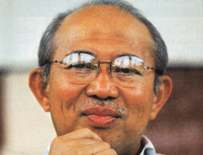
 Those who govern must be transparent, must be prepared to be corrected and must be willing to allow public participation in their decision making process.
