
|
|||||||||||||||
| Watch what they say!
by Dr Shakila Manan
Please support our work by buying a copy of our print publication, Aliran Monthly, from your nearest news-stand. Better still take out a subscription now. We also welcome donations.
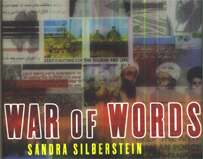
Scholarly books on the role of language in constructing national identities are typically written in language accessible only to those who possess background knowledge of linguistics and textual analysis. War of Words is a welcome exception. The book demonstrates how language was deployed by the Bush administration and the American media, after September 11, to �manufacture consensus� among Americans and re-invent a national identity to support an all-out �war against terror�. Vilify, justify Sandra Silberstein cleverly probes the �underside of patriotic rhetoric� to reveal the use of written, oral and visual language to construct a nation in crisis, and to vilify the enemy, in order to justify the USA�s aggressive stand on terrorism. This strategy, Silberstein succinctly argues, is crucial for those in power and for the media who seek to foster national unity in a time of shock and grief. Silverstein�s detailed analysis of President Bush�s post-September 11 speeches shows how certain features of his language, specifically the use of pronouns, grammar and �speech acts�, were meant to construct America as a �united nation� headed by a �firm� and �reassuring� President who was �in control� of the situation. Bush�s speeches used �war rhetoric� marked by selective reporting. They sought to demonise the enemy and to silence dissident voices while garnering support for invading and occupying Afghanistan. To justify the bombing of Afghanistan, by linking the Taliban with Al-Qaeda, for example, Bush�s selective reporting suppressed vital details, including other reasons for war such as the conduct of the war to fortify and consolidate America�s global supremacy. Framing remembrance
With carefully chosen visuals, subtitles and commentaries, the national and local television networks conflated various political, military, religious and cultural spheres to boost Bush�s satus as President and Commander-in-Chief, and endorse his future policies. For the rest of the world, the event was to be a signal of the �togetherness of Americans� fervently praying for unity and peace, despite their differences of creed and colour. Survivors and spectators Silverstein�s narrative analysis of the media�s portrayal of the September 11 survivors� identities and stories deftly dissects the media�s �televisual displays of nation� that constructed a �collective identity� binding viewers to survivors. Hence, �news� and �entertainment� converged in a �media spectacle� of survivors� harrowing accounts and and other people�s personal responses. In technical terms, newscasters used certain descriptors and rhetorical devices to achieve this effect while avoiding a critical and comprehensive coverage of September 11. In the process, the media made New York �America� and its mayor, Rudy Giuliani, �America�s mayor�. New York was transformed into a �national symbolic site�, while the attack on the Twin Towers became �The Attack on America�. To that degree, even foreigners who perished were New Yorkers and thus Americans, while Guiliani, a mayor with a blemished past, was reinvented as a hero whose paternal role during the crisis was balm to shattered psyches. Selling and silencing Advertising, too, had its day in �selling America�. The Ad Council of America, USA�s �national propaganda organ�, in Silverstein�s words, used advertisements to forge solidarity in the melting-pot society by invoking cherished values such as �tolerance�, �diversity�, �unity�, and �patriotism�. Thus the repeated peddling of such slogans as: �I am an American�, �Americans stand united�, and �Proud to be American�. These advertisements, borne by shopping bags, postage stamps and flags, in fact conjoined �patriotism� to �consumerism�. One of Silverstein�s most important analyses focuses on a report issued by the conservative American Council of Trustees and Alumni (ACTA) established in 1995 by Lynne Cheney, the Vice President�s wife. The ACTA�s report targetted people in academia and among the literati who were accused of wanting to adopt a �blame America first� attitude. Silverstein is correct in labelling the ACTA�s move as a witchhunt to intimidate critics of American policy. By separating the critics from �mainstream America�, the ACTA�s action, in tandem with emerging legislation, notably the Patriot Act, � was a clear attempt to stifle dissent. Not surprisingly, the overall curtailment of freedom of speech was useful to the media�s �schooling America� about Islam. Silverstein exposes an ABC newscaster�s tactless deployment of military and minefield metaphors in his descriptions of Islam and Muslim nations. Rather than create an informed understanding of Islam and Muslims, such descriptions strengthened stereotypes of Islam as a dangerous religion and the Muslim world as a menace. Although a CNN documentary tried to lessen the false impressions, the media generally devoted much time to the pitfalls and dangers of (Islamic) extremism. Silverstein�s book will repay a careful reading, not least for a reader with no prior training in linguistics but a healthily sceptical attitude towards the �war of words� that was the prelude to the invasion of Iraq by the so-called �Coalition of the Willing�.
Now e-mail us and tell us what you think. | |||||||||||||||

 In the process, the media made New York �America� and its mayor, Rudy Giuliani, �America�s mayor�. New York was transformed into a �national symbolic site�, while the attack on the Twin Towers became �The Attack on America�.
