
|
|||||||||||||||
|
Amendments to the Criminal Procedure Code:
Aliran's representation to the Parliamentary Select Committee Aliran Monthly Vol 24 (2004): Issue 10
Please support our work by buying a copy of our print publication, Aliran Monthly, from your nearest news-stand. Better still take out a subscription now. If you prefer to read our web-based edition, please support our work and make a donation.
It has been Aliran�s stand all along that Bills for debate should be made known to the public at least three months before they are considered for adoption. It has been our view that it is the democratic right of citizens to comment and participate in the enactment of any law. It is of utmost importance since laws enacted by Parliament would invariably affect us, the citizens. As such, it is imperative that the views of citizens must be taken into consideration. Welcome departure This consultation is also a welcome departure from the past deplorable practice of tabling the Bill at the eleventh hour without even giving our elected representatives time to study the Bill diligently and debate intelligently. Bills must never be rushed through. However, we wish to highlight that there was very little publicity about this consultation nor, it appears, were individuals and groups encouraged to come forward. On our part we only recently heard about this event through the NGO grapevine In countries like India, Australia and the United Kingdom which practise a Westminster system of democracy, the setting up of Parliamentary Select Committees and conducting public hearings to study proposed bills are common occurences. Indeed, consultation of one�s own citizens prior to the making of laws and policies is a hallmark of any democracy worth its name. We like to believe that we will not have to wait another 20 years before we are invited for another consultation! Having said that, let us turn to the business of the day that is to comment on the proposed amendments to the CPC which the government believes is necessary in order to combat terrorism. It is our contention that we already have too many coercive laws which have allowed the government to act rather arbitrarily. The proposed amendments, we contend, are redundant. PROPOSED AMENDMENTS TO THE CRIMINAL PROCEDURE CODE Section 106B; Powers of arrest What is provided for under this section is shocking. It smacks of a police state. It is unthinkable that any police officer may arrest without warrant any person whom he has reasonable grounds for suspecting to have committed or to be committing a terrorism offence. Take note of the words: has reasonable grounds for suspecting. It does not emphasize valid grounds neither does it mention definite evidence � only reasonable grounds for suspecting. How can suspicion be reasonable? On what basis can suspicion be construed as reasonable ground for arbitrary arrest? Can action based on suspicion be ever justified? This is a dangerous provision with a great potential for abuse and corruption. This provision has an intimidating effect and can force people to cooperate under coercion. Arrests must only be made with a warrant, for valid reasons, and based on reasonable evidence of wrongdoing. In a civil society such undemocratic provision should have no place. Section 106C: Power to intercept communication and admissibility of intercepted communications This whole section unfortunately reflects the characteristics of a police state with unbridled power in the hands of one person. The Public Prosecutor solely decides and acts without restraint and he is beholden to no one for his action. On a mere suspicion based on a likelihood, he is armed with limitless powers to make a mockery of the rule of law and invade our privacy and have access to our confidential matters. He can snoop and spy on us, listen in on our conversations, tap our phones and bug our homes. And he is accountable to no one. He can act on dubious grounds - as long as he considers that it is likely. He presupposes that a crime is likely to take place and acts on that basis. Arising out of this presumption, he can intercept, detain and open any postal article, intercept any message, intercept or listen to any conversation, install any device in any premises. He has that kind of vast authority that does not question his right to do all of these things. And this is disturbing. When so much power and arbitrary authority is vested in the hands of one person, justice will be trampled upon and every man�s freedom is at stake. This wide, unfettered powers vested in the hands of one individual will unfortunately and ultimately lead to the abuse of the rights of the citizens. Dissidents and opposition figures can easily fall prey to this provision. They can be hounded and harassed. Where surveillance (such as interception and wire-tapping) is required to safeguard the security of the state, the court must establish whether there is any genuine justification for such measures. Only with the moral authority of the court can such serious surveillance that invades the personal privacy of a person be allowed. Whatever authority conferred by these proposed amendments on the Public Prosecutor on what is clearly flimsy grounds - i.e. if he considers that it is likely or has reasonable grounds for suspecting - must be removed. Section 107A: Report on status of investigation This amendment permits an informant to request for a report on the status of the investigation of the offence complained of. However, we are concerned that this is only limited to seizable offence. Any complainant should be entitled to receive on request a status report, as a matter of right. That right should not be given on qualification only. Indeed, it should be mandatory and should be given even without any request made. If the police need the cooperation of the citizens, they are also morally obliged to cooperate with them. When citizens are convinced that their complaints will receive the attention of the authority and be investigated, they will be encouraged to come forward to make reports. The only way to encourage them is to make available the investigation status report so that they will not come to the conclusion that it was a waste of time and effort. Clause (3) (c) is arbitrary and cannot be sustained. This provision can be used quite easily to deny the status report on the ground that it contains information that is likely to adversely affect the investigation into the offence or the prosecution of the offence. Surely, rather than denying the complainant the entire report, couldn�t some aspects of the investigation be made known to him? Section 227B: Evidence through live video or live television links While we agree that in certain circumstances it may be prudent - even necessary - to give evidence through live video or live television links, such decisions must be left to the court. Aliran disagrees with the involvement of the Minister in deciding this as is suggested under Clause 2 (c): such other offences as the Minister may, after consulting the Chief Justice and the Public Prosecutor, prescribe. It mentions such other offences without defining them. What can these other offences be? It gives the Minister absolute discretion and authority to do as he likes. In particular, ISA detainees should not be allowed to testify by video or tele-conferencing; rather, they should be produced in court to establish that their testimony is voluntary and to allow for cross-examination. It must be recognised that they are essentially in the custody of the authorities and may be coerced into giving the �right� testimony in exchange for their early release or to avoid being penalised with extended detention. PENAL CODE (AMENDMENT) ACT 2003 Date of Royal Assent: 17 December 2003. Date of publication in the Gazette: 25 December 2003 The essence of Act A1210 of the Penal Code(PC) (Amendment) Act 2003 is with regard to the insertion of a new Chapter VIA �Offences Relating to Terrorism� to the Penal Code. This amendment was passed by Parliament in 2003, given Royal Assent on 17 Dec 2003, and then gazetted on 25 December 2003, on Christmas Day. Alas, such an important change to the Penal Code was made without soliciting the views of ordinary citizens and groups. We are encouraged that the CPC Amendment Select Committee is now giving us an opportunity to comment on the amended Penal Code as well. Aliran believes that there is a fundamental flaw in this new Chapter VIA of the Penal Code. Interpretations are given to define/clarify the meaning of �entity�, �explosives�, �harbour�, �imprisonment for life�, �master�, �operator�, �property�, which are then used to clarify the meaning of, among others, �terrorism financial offence�. But there is no substantive definition/clarification/interpretation of �terrorist�, �terrorist entity�, �terrorist group�. As we well know in the case of Palestine, it is very difficult to determine who is the `terrorist: is it simply the Palestinian who resorts to arms to get rid of the Israeli occupiers? Or is it the Israeli state which uses force of arms to deny the Palestinians their rights? In the case at hand, the interpretations given are �tautological�, meaning that one is saying the same thing twice over in different words. For example, under 130B (1) �Interpretation in Relation to this Chapter�, it is stated: �terrorist� means any person who �It is only under 130B (2)a to 130B (2)j that the definition of what constitutes a �terrorist act� is given. And here, it is too general and too wide in scope, ranging from
By not giving more substantive clarifications of �terrorist acts� and who constitutes a �terrorist�, the Penal Code as recently amended grants even more arbitrary powers to the authorities. Words such as - attempts to commit, is likely to be used, may reasonably be regarded as being intended to - can mean anything to enable a person to be detained. It is an action based on presumption and goes against natural justice. In this regard, Section 4(1) (e) as amended is cause for alarm. It refers to any offence by any person to compel the Government of Malaysia or the Government of any state in Malaysia to do or refrain from doing any act. What constitutes an offence is open to wide interpretation and may include anything and everything. If a certain person or certain section of the citizenry disagrees with some policy that the government is intending to implement and undertakes certain measures to oppose it, would that amount to compelling the government to refrain from doing it? If we as citizens oppose the Penang Outer Ring Road, toll hikes or petrol price increases, for example, would it mean that we cannot lobby, cannot exert pressure, cannot hold forums, cannot collect signatures to convey our opposition to these decisions? Such actions are aimed at pressuring the government to refrain from implementing its plans or reversing its decisions. Perhaps this Clause is not intended to be used in that manner, legally speaking. But if someone chooses to interpret the Act as it stands, he won�t be wrong. If an opposition party were to engage in a democratic, legitimate exercise to oppose a particular government policy, how would that be viewed under this Clause? Section 130C: Committing terrorists acts We are also concerned how evidence that a terrorist act has been committed is determined. Under Clause (2) what is deemed as sufficient evidence is very disturbing and undemocratic. It is stated: a certificate purporting to be signed by an appropriate authority to the effect that the item or substance described in the certificate is a weapon, a hazardous, radioactive or harmful substance, a toxic chemical or a microbial or other biological agent or toxin shall be sufficient evidence of the facts stated in it. It is very upsetting that this certificate is not even signed by an expert. It is a certificate that is purporting to be signed by an appropriate authority. No one knows what this means or how qualified or credible this �appropriate authority� is. The fact that such intentions couched in vague language can creep into our statute books can only raise improper motive and nothing else. Conclusion This country already has too many coercive laws and adding more stringent laws to this arsenal is not going to make us any safer. It will certainly not make us more democratic. Nonetheless, we welcome this once in 20-years opportunity to share our views directly with a Parliamentary Select Committee. We hope that there will be many more opportunities to do so. It is our earnest wish that you will succeed in presenting the submissions that you have received from various sectors of Malaysian society to your parliamentary colleagues. Your recommendations to Parliament must include our views and concerns as well as those expressed by others who have appeared before you. These citizens� views should then be reflected in the Bill when finally adopted to give this whole consultation exercise real meaning. Otherwise, this whole exercise would have been a waste of time and public funds. It is important for Parliament to be viewed as an institution that is sincerely concerned with human rights issues, even as we discuss how to combat terrorism. It must be seen as an institution that safeguards the people�s security while standing up for the rights of all citizens. Ultimately, Parliament should stand out as a symbol of justice - that is our prayer.
Now e-mail us and tell us what you think. Your comments might be published in the Letters section of our print magazine, Aliran Monthly. | |||||||||||||||

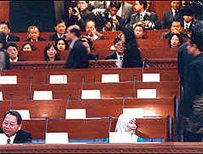
 It is important for Parliament to be viewed as an institution that is sincerely concerned with human rights issues, even as we discuss how to combat terrorism.
