
|
|||||||||||||||
|
Surviving rape in Darfur
by Josef Roy
Please support our work by buying a copy of our print publication, Aliran Monthly, from your nearest news-stand. Better still take out a subscription now. If you prefer to read our web-based edition, please support our work and make a donation. For a US$10 donation (via credit card)  For a US$25 donation
On 19 July 2004, Amnesty International launched a report on Sudan: Darfur, Rape as a Weapon of War, (AI Index: AFR 54/076/2004). The report revealed that rape was widespread and often systematic. Rape has been used by the Janjawid militia and some government soldiers to humiliate the women, to instil fear and control them, to force them to leave their homes and thus destroy the social fabric of their communities. The horror of sexual violence
The long-term consequences In addition to the immediate and very serious physical and mental health effects of the act of rape, there are longer-term consequences for rape survivors in Darfur. Given the shame and stigma associated with rape, women are often reluctant to report it to any medical workers - which can lead to further complications of their injuries. At present in Darfur there are not enough trained medical workers to identify and treat survivors of rape. There are also not enough medical facilities to treat any sexually transmitted diseases that can be spread through rape. The consequences of this lack of medical support for rape survivors is severe. Sexual violence can have serious and lasting consequences. Women whose reproductive systems have been damaged by rape may be rejected by their husbands for not fulfilling their role as �reproducers�. Survivors of rape and their children are most likely to be ostracised by their community. A child born as a result of rape may be considered a child of the �enemy�, a �Janjawid child� and women can feel forced to abandon the child born. The stigma attached to survivors of rape has far-reaching social and economic consequences. Married women may be �disowned� by their husbands. Unmarried women may never be able to marry because their communities consider them �spoiled�. Raped women who are not able to marry or who have been abandoned by their husband are socially and economically more vulnerable in Sudan: they cannot enjoy the �protection� or economic support that men are traditionally expected to provide. Some refugees in Chad told Amnesty International that the bride price has greatly decreased in the camps. Some parents fear that it will be impossible to protect their unmarried daughters from sexual assault and thus seek to �marry off� their daughters even earlier than is customary to save family honour. Girls are increasingly being married to anyone who can pay a bride price, which can put the child brides at risk of abusive spouses. The Government of Sudan�s response On 17 July 2004, the Sudanese Justice Minister Ali Mohamad Osman Yasin announced that three committees - for each of Darfur�s three states and comprising women judges, police officers and legal consultants - would investigate accusations of rape and help victims through criminal cases. Amnesty International is concerned that in the past, Sudanese who have come forward to report abuses were punished, whilst no action was taken against the perpetrators. At the launch of Amnesty International�s report in Beirut on 19 July 2004 Mohammed Bakhit, the Sudanese Ambassador to Lebanon denied the existence of rape in Darfur: �If there were cases of rape in Darfur they would not exceed two cases, � he stated. However, Amnesty International continues to receive new reports of abductions and sexual assault in Darfur: on 27 July, the UN reported that dozens of women and girls under 15 years of age had been raped by Janjawid militia in and around Sisi camp for internally displaced persons in West Darfur. On 1 August seven girls were reportedly attacked when venturing outside Swani camp, also in West Darfur, to collect firewood. All but one later escaped: the whereabouts of the abducted, newly married, 20-year-old woman remain unknown. The international community�s response Individual states and regional institutions such as the African Union, the League of Arab States and the European Union, have all denounced the human rights violations in Darfur. Humanitarian relief is now reaching more people in need in Darfur and the refugee camps in Chad. Necessary political, financial and technical assistance to the African Union ceasefire observer mission in Darfur has increased and eight UN human rights monitors are being deployed to the region. However civilians in Darfur continue to be attacked, intimidated and arrested. UN Security Council Resolution 1556 of 30 July 2004 has demonstrated increased world attention to the plight of civilians in Darfur; however, measures to address the appalling human rights situation remain sidelined. The resolution fails, inter alia, to create an international Commission of Inquiry to examine evidence of war crimes and crimes against humanity including rape and other forms of sexual abuse, as well as to investigate allegations of genocide.
Now e-mail us and tell us what you think. Your comments might be published in the Letters section of our print magazine, Aliran Monthly. Alternatively, post your comments to the message board. | |||||||||||||||

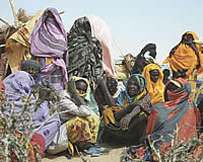
 At present in Darfur there are not enough trained medical workers to identify and treat survivors of rape.
