
|
|||||||||||||||
|
Calls for “reformasi” in food and agriculture The launch of the People's Caravan 2004 in Malaysia
by Susan Loone
Please support our work by buying a copy of our print publication, Aliran Monthly, from your nearest news-stand. Better still take out a subscription now. If you prefer to read our web-based edition, please support our work and make a donation. For a US$10 donation (via credit card)  For a US$25 donation
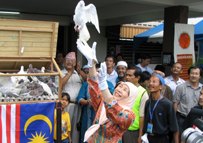
Organised by the Pesticide Action Network’s Asia Pacific office together with local host Tenaganita, the Caravan is an internationally-linked event involving thousands of farmers and agricultural producers in Asia and Europe. The Caravan, carrying the banner “Asserting Our Rights to Land and Food”, visited us in Permatang Pauh, Penang on Merdeka day. It was launched by Permatang Pauh Member of Parliament Wan Azizah Wan Ismail. Other organisers of the one-day programme in Permatang Pauh were local people’s movements such as Save Ourselves (SOS) Penang, Suara Rakyat Malaysia (SUARAM) and the Permatang Pauh Residents Association. After Permatang Pauh, the Caravan team visited two other states in Malaysia. Hundreds of plantation workers and indigenous groups in Perak and Selangor heard similar messages of reformasi and solidarity such as “Women Say No to Pesticides”, “WTO out of Agriculture”, “Food Not Bombs”, “Uphold the Ban on Paraquat”, “No to GMO” and “Resist Agrochemical TNCs”. Reformasi in food and agriculture When she arrived at the Caravan launch site at Dewan Teochew in Tanah Liat close to the Bukit Mertajam town centre, Wan Azizah, who is also Parti Keadilan Rakyat’s president, was greeted by the thumps of the Malay kompang followed by a rousing lion dance and Chinese drum performance. She was accompanied by PAN AP executive director Sarojeni Rengam, Tenaganita director Irene Fernandez, Asia Pacific Research Network chairperson Antonio Tujan Jr, and the All Nepal Peasants Association chairperson and secretary general Bamdev Gautam and Prem Prasad Dankel.
And to illustrate just that, Wan Azizah handed over seeds and soil to the Nepalese peasant leaders who were guests at the event. The seeds and soil will be brought back to Nepal for the Caravan’s climax at the end of September. Before that, simultaneous programs on food sovereignty, rights to land and food, globalisation and resistance against international institutions like the World Trade Organisation, International Monetary Fund and World Bank will be conducted in the countries visited by the Caravan. Later at the launch, a VCD presentation on “reformasi” in agriculture, depicting a local farmers’ uprising in the early 1970s and other struggles in the 80s as well as excerpts of jailed ex-deputy prime minister Anwar Ibrahim’s speeches on agricultural reforms caught the crowd’s attention. Anwar, Wan Azizah’s husband, was freed by the Federal Court two days later and then left for Germany, where he is now recuperating from minimally invasive spinal surgery. “We are in a dire need of a reformasi in the agricultural sector, which has been neglected for far too long,” Wan Azizah said in her Merdeka message, while launching the event. “We must take necessary steps which can strengthen the farmers’ movements because these are the people who have built this country with their sweat and blood, although they are often the first ones to be abandoned,” she added. Shocking revelations Meanwhile, at the Permatang Pauh event, Sarojeni revealed findings of a study conducted in Perak, which found 82.2 percent of Orang Asli children suffering some manifestation of vitamin A deficiency. At her welcoming speech, Sarojeni made further revelations that rural Malaysian children were overall found to be “underweight and stunted”, adding that 20 percent of our children were malnourished. “In a country which prides itself on being a newly industrialising nation, this is totally unacceptable,” she told the 1,000-odd participants who attended the event, some of whom had travelled 100km to share in the joy of the Caravan. “We have the third tallest twin towers in the world and the longest bridge in South East Asia, yet we cannot feed our people,” she added. Sarojeni said patriotic Malaysians should also be concerned for the welfare of our people because Malaysia spends about RM13 billion for imported food while water rights are being privatised, unsafe food is being produced everywhere and the costs are being passed onto consumers. “Our health is being affected by pesticides and potentially by genetically engineered food and crops,” she said. The right to adequate, culturally appropriate and safe food is one of the rights under the ambit of food sovereignty. Paradoxically, it is the small producers and their families in the region who toil the land to produce food for all of us who are the ones who suffer from hunger and malnutrition. Their work and toil is being exploited by the landlords, the elites and now corporations that control the land and productive resources such as seeds, water, forests, knowledge, and appropriate technology - all of which are needed to produce food. It is also happening in Malaysia with corporations now poised to take over control of land belonging to small farmers and even Malay reserve land. Globally, three TNCs control 75 percent of the world market of pesticides and 90 percent of the market of genetically engineered seeds. These TNCs are from North America and Europe. The same TNCs are also working hand-in-hand with some governments to exploit the biodiversity of our countries to reap profits. For example, our government is now inviting these TNCs to set up their research and development in Malaysia, by attracting these companies with biodiversity resources, particularly in the east coast, Sabah and Sarawak. Crossroads in agriculture The People’s Caravan in Malaysia moved from Permatang Pauh in Penang to Hutang Melintang in Perak, where there was a Forum Rakyat (People’s Forum) and Concert focusing on globalisation, pesticides and the rights of agricultural workers. From Perak, the caravan team headed for Pulau Carey to be with the Orang Asli community whose land was taken away by Yayasan Selangor for development and then for a program with the community in Kapar focusing on health and food safety. The Malaysian Caravan ended with a gathering of more than 700 Nepalese migrant workers in Port Klang. Durning her kick-off speech in Permatang Pauh, Tenaganita director Irene Fernandez said Malaysians were at the crossroads in the agriculture sector. “Agriculture is Malaysia’s Prime Minister’s agenda. But it is to move agriculture into where they want to make billions of profit,” she said. “It is an agriculture that will rob us of our lands and our biodiversity, which is being eyed by multinational corporations for profit,” she added. Irene said we were called to resist this agenda, which will result in our farmers becoming landless labourers, our fisherfolk becoming cheap workers, our indigenous people landless and losing their identity, our agricultural workers further exploited. “We are called to resist because the safety of our food is at risk; the dependence on food imports will increase; and our environment (will be) destroyed,” she said. “We, as a people, as Malaysians for justice, must respond because our country is our responsibility,” she added.
Now e-mail us and tell us what you think. Your comments might be published in the Letters section of our print magazine, Aliran Monthly. Alternatively, post your comments to the message board. | |||||||||||||||

 We are in a dire need of a reformasi in the agricultural sector, which has been neglected for far too long.