
|
|||||||||||||||
|
Shattered dreams and restored hopes 22 migrant workers head for Putrajaya in a last-ditch effort to avoid deportation
by Joachim Francis Xavier
Please support our work by buying a copy of our print publication, Aliran Monthly, from your nearest news-stand. Better still take out a subscription now. If you prefer to read our web-based edition, please support our work and make a donation. For a US$10 donation (via credit card)  For a US$25 donation
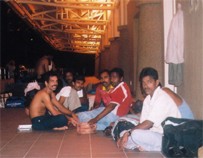
Shattered dreams Sheeva and 21 other workers, all from India, are victims of a well-organised scam to cheat and supply cheap foreign labor to local industries. The players include irresponsible recruitment agents, unethical companies and ignorant government officials in the country of origin and the host country. Having forked out between RM8,000-RM10,000 to pay for their way here, the workers were devastated when they eventually realised that they were duped into believing they would receive a basic salary of RM750 for an eight-hours-a-day, six-days-a-week job. After a month in employment they received only RM350, less than 50 per cent of what they were promised. To cut a long story short, they eventually sued the employer, Chin Well Fasteners Sdn. Bhd, with the help of lawyers from the Consumers Association of Penang (CAP). In June 2003, they won. The court instructed the company to pay all that was contractually due to the workers. The company appealed and successfully applied for a stay of execution. It has been 13 months since then and the Court of Appeal has yet to set a date to hear their case. (Since this article was written, the Court has finally fixed a date in October 2004.) As the workers waited for justice to be done, the employers went on a witch-hunt. Since the High Court judgment, the company systematically terminated the workers and had the Immigration Department cancel their work permits - effectively making all of them undocumented migrants. Therefore, Sheeva and his friends now have to return to India or face the possibility of detention, whipping and deportation. To make matters worse, Home Affairs Ministry (Kementerian Dalam Negeri) policies do not allow terminated workers to seek alternative employment while waiting for their case to be heard. This policy totally cuts off much needed income causing them at times to be without food and medical attention for long periods. Numerous appeals were made by various parties requesting the Government to allow the workers to stay in Malaysia and for the hearing of their case. The Government was also requested to allow them to work and sustain themselves. Their pleas were denied � often, ignored. As of August 2004, the workers did not posses any valid documents. The law now effectively defines Sheeva and his friends as illegal migrants � deserving harsh punishment. Something had to be done... My office, the Penang Office for Human Development (POHD), which is the social service arm of the Catholic Church in the Northern Diocese, decided it was time to act pro-actively. Since we did not receive a reply to two of our letters to Human Resources Minister Dr Fong Chan Onn, we figured it was time to go to the Ministry directly and ask for a resolution to the almost hopeless situation. We set the date for 24 August 2004. On the morning of 24 August, the 22 workers and I boarded a bus and began our journey to Putrajaya. We did not know what lay ahead of us but we certainly knew what we wanted. About two hours into the journey, the bus was flagged down at a police road block. After checking the work permits of the workers (which were now not valid), the policeman said he would have to detain the workers. I gently negotiated with him informing him of the purpose of our trip and showed him all the documents, which proved that the workers had not entered the country illegally but were made illegal by the employers and Immigration policies. I also explained to him the workers had a case pending in the Court of Appeal. He did not seem convinced. Nevertheless, after 40 minutes of persistent negotiations, he miraculously allowed us to continue with our journey. "No time for small matters" At the Human Resources Ministry, we asked to see Dr. Fong. The Private Secretary to the Minister quickly brushed us aside saying that the Minister did not have time for �small matters such as this.� I firmly pointed out to him that when lives are at stake, the matter is no longer small. I also informed him the workers were not going to leave Putrajaya until they received some satisfactory answers to their predicament even if they had to sit in the building for a week. We were then referred to several high-ranking officials including the Human Resources Ministry secretary-general, deputy secretary-general, and the director-general of the Industrial Relations Department. Save for the private secretary of the Human Resources Ministry, we were treated cordially by all who met us. Some of the officials were sympathetic and even acknowledged that contradictory policies indeed exist within the system. I was pleasantly surprised! Nevertheless, none of the officials I met could make a decision to resolve the problem stating that either these were policy matters to be decided by the Ministers or that it was outside their jurisdiction! Finally, insisting that I be put to someone who makes decisions, the Human Resources Ministry secretary-general referred us to the Home Affairs Minister the following day, promising to make a call on our behalf to the Ministry. Under the night sky of Putrajaya That night we had no place to go. The workers had no money for transport or accommodation. We resolved to rough it out wherever we could � even if it was under the open sky. Our earlier request to spend the night on the grounds of the Ministry was denied. The security officer was nevertheless very kind � I had explained to him what had happened to the workers - and he suggested that we spend the night at an express bus station located nearby. Having no other choice, we did just that. My only concern was the police. I knew that the police made regular rounds around Putrajaya after dusk. We would just have to risk it. True enough, that night, the police did turn up and questioned our presence there. It was the second time that day we had come so close to being detained. It was only after I had explained that we had a meeting with the Home Affairs Ministry the following day did he let us go. I wondered for how long more we could keep the police off our backs � Victorious! The next morning we proceeded to the Home Affairs Ministry. After waiting for about an hour and after being informed that the Home Affairs Minister was busy, a senior official representing the secretary-general of the Home Affairs Ministry met with me and the workers. Expressing his desire to speak with the workers alone, he discussed with them their predicament. Two hours later, the Home Affairs Ministry approved 22 new work permits and even helped to refer the workers to a new employer in PJ. The employer, who eventually visited the workers at the Home Affairs Ministry later that day, owns a chain of nasi kandar restaurants. He agreed to take in all the 22 workers effective 1 September 2004. The Ministry had also directed the Immigration Department to send enforcement officers to secure the worker�s passports from the former employer who despite numerous requests had refused to release the documents to the workers. The workers were jubilant and I was lost for words at the quick and effective intervention of the Home Affairs Ministry. Not an isolated case While POHD and many others involved in this long-drawn ordeal are very pleased with the outcome of this particular case, we must remember that the problem faced by these Indian workers is not an isolated one. Our office and other migrant workers-based organisations have handled many situations where workers who are seeking redress, using local justice apparatus � be it the Industrial Court, Labour Court or Civil Court � do not have the opportunity to legally stay on, sustain themselves through gainful employment and see their case through to completion. Several factors contribute to their problem:
We also believe that the lack of punitive action to rein in errant employers who terminate the services of workers wantonly have encouraged a dangerous trend as far as large scale terminations are concerned. Today, it is common for an employer to threaten a migrant worker with termination the minute he or she questions any contractual obligation or irregularity. When migrant workers persistently ask for what is rightfully theirs, employers terminate the services of workers knowing full well that Immigration policies would ensure their swift detention, punishment and deportation. Employers are also aware that any redress sought from available avenues would be short-lived as Home Affairs Ministry policies would ensure that the workers would not be able to work, earn and �out-last� the employers in a legal battle. Genuine fears and inherent rights That said, my discussion with Home Affairs Ministry and Human Resources Ministry officials has revealed the reasons for the Ministries� inertia in reviewing these policies. There is a genuine fear that if migrant workers are allowed to stay to seek redress from the local justice system, they may take advantage of the system to further their aims for an extended stay here in Malaysia. We acknowledge such concerns. They are real and to some extent, true. Nevertheless, the right to seek redress is an inherent right and no policies whatever their merit should deny that right - no matter what the potential abuse may be. Perhaps a balance needs to be struck between the need for policies that are just, the practical implementation of these polices and the check and balance mechanisms that ensure the system is not abused - both by employers and migrant workers. To that end we sincerely hope that the Home Affairs Ministry would look into these issues urgently. We have faith in their ability to do so � especially when they set their minds to it. Our little experience at Putrajaya has demonstrated to us that there are individuals in the Ministries who do indeed care, are concerned about the welfare of migrant workers, and see the need for change. All that is needed now is the political will to translate that care and concern into policies that respect the rights of all migrant workers � including the right to seek redress. Restored hopes As we celebrate Merdeka, Sheeva would also be celebrating his little �merdeka� knowing that the Government�s swift decision on 25 August has liberated him and his friends from the shackles of oppression and injustice that had threatened to rob him of everything including his livelihood. He now has a place to stay and would not go a day hungry. He would be able to stay legally and see the resolution of his case in the Court of Appeal. Best of all, he has another shot at fulfilling the dream he has harboured in his simple but hopeful heart for so long - starting an electrical appliances shop and getting married� But let us spare a thought for the countless other �Sheevas� in our midst who are still waiting and hoping for redress and justice. We need new policies and the political will to protect and uphold the rights of migrant workers who have toiled and helped to develop our land.
Now e-mail us and tell us what you think. Your comments might be published in the Letters section of our print magazine, Aliran Monthly. | |||||||||||||||

 Our little experience at Putrajaya has demonstrated to us that there are individuals in the Ministries who do indeed care, are concerned about the welfare of migrant workers, and see the need for change.