
|
|||||||||||||||
|
COVER STORY
The house of the rising sons
What they didn�t debate at the UMNO general assembly
by Khoo Boo Teik
Please support our work by buying a copy of our print publication, Aliran Monthly, from your nearest news-stand. Better still take out a subscription now. If you prefer to read our web-based edition, please support our work and make a donation.
Or, as Barisan Nasional politicos so cheaply love to taunt their critics and the opposition with it, �NATO� � �No Action Talk Only�, except the BN types wouldn�t dare to apply it to UMNO�s first General Assembly to be held in 22 years without Tun Dr Mahathir Mohamad�s presiding influence. But look at what transpired, or didn�t, during the Assembly. UMNO endorsed its new President, Prime Minister Dato� Seri Abdullah Ahmad Badawi, and his deputy, Datuk Najib Tun Razak, without any fuss. That, however, was a foregone conclusion after the Mahathir-Abdullah transition and the March general election. There being no genuine excitement over serious issues, a bit of B-Grade drama was provided by some complaints that �money politics� had influenced the results of the party elections at the Vice-President and Supreme Council levels. Predictably, �Inverse Relevance� took over, followed by � �NATO�: those complaints were raised and dropped with no evidence that real offenders will be identified and real action taken against them. Failure baru or ubat lama (New failure or old medicine)? For that matter, there was a lot of talk about �the Malay agenda� and the New Economic Policy, matters that supposedly define UMNO�s unfulfilled mission. Exhortation came after exhortation but no speaker offered anything more refreshing than old refrains. Change the �Malay mindset� (whatever this can possibly mean)! Imbibe new values to stay competitive (as if no one had read or heard Dr Mahathir before)! Now that we�re living in the era of Wawasan 2020 (Vision 2020) and the National Development Plan, what did the Assembly offer for public debate besides the ubat lama(old medicine) of the Revolusi Mental (Mental Revolution) type? Is the NEP just beginning instead of its having been implemented for over 30 years? Judging by the drift and tone of the Assembly proceedings, UMNO�s presentation of its �Malay agenda� couldn�t answer a major riddle that bedevils not simply the �Malay share of the economy� but the national economy itself. How did the Melayu Baru (New Malay), so confident before the East Asian crisis of 1997, become non-competitive after the crisis? Lest anyone accuse me of stirring a hornet�s nest, hear this response from Dr Mahathir. He said simply that if the Malays kept selling off their assets, the restructuring targets couldn�t be met even if NEP were to be extended �a thousand years�. Dr Mahathir wasn�t just being rhetorical. He added a point not publicised by any political figure before. Had the Malay beneficiaries of government projects and contracts held onto their assets, Dr Mahathir observed, the �Malay share of the economy� would have been 40�50 per cent today. Back to Reformasi Of course, Dr Mahathir has retired, and, before that, he�d despaired that he�d failed the Malays, or perhaps the Malays had failed him. Maybe no one listens to him any more. Yet, shouldn�t so frank a criticism from the NEP�s best known defender and most dedicated practitioner have altered the complexion of UMNO debates over restructuring targets and quotas? Or are we condemned to listen to �debates� that spar inconclusively around metaphors � crutches, wheelchairs, and hornet�s nest � or speak vaguely but at times alarmingly about the �dangers� facing an entire race? If someone genuinely wants to do something other than exhort others, why isn�t there an earnest reassessment of past and present practices and a full-scale audit of corporate and government failures in privatization? Only action to that end can truly support an accountability-driven and disclosure-oriented move by Abdullah Badawi�s �anti-corruption� and �good governance� administration to resolve this longstanding �debate� over unachieved targets. Until or unless action of that sort is seen, Abdullah Badawi�s policy initiatives should be seen as quick-fix responses to Reformasi�s demands for clean government in a post- Reformasi milieu disapproving of �corruption, cronyism and nepotism�. Abdullah�s limited measures of �transparency� were credible and effective because the public had wearied of mega projects, corporate arrogance and a disdain for popular concerns. What's new about Islam Hadhari? Other than that, has any new vision emerged after Dr Mahathir�s departure except perhaps �Islam Hadhari�? At the March general election, PAS was UMNO�s only serious target, and PAS had staked its electoral fortunes on its �Islamic State� goal. Thus, UMNO could logically credit its victory to a vision of Islam that was more reassuring for most voters than PAS�s �Islamic State Document�. Even so, it�s doubtful UMNO�s victory over PAS in the East Coast owed much to religious appeals per se. While some PAS quarters have reacted negatively toward Islam Hadhari, other observers have remarked that Islam Hadhari contained �nothing new�, conceptually or substantively. Whether or not that�s true, Islam Hadhari was politically �new� in at least three ways. First, Islam Hadhari replaced, or was seen to replace, Dr Mahathir�s Islamisation policies that had worn rather thin during the 1998�99 crisis. Second, Islam Hadhari offered a �moderate� and �progressive� Islam in a time of heightened global suspicion of anything �Islamist�. And, third, with Malaysia presiding over the Organization of the Islamic Conference, Islam Hadhari allowed Abdullah to internationalise UMNO�s religious credentials beyond their former association with only national development. Yet the UMNO General Assembly spent little time clarifying many social and political implications of implementing Islam Hadhari. For example, does Islam Hadhari condone the use of the Internal Security Act, the Sedition Act and the Official Secrets Act? Does the �moderation� impled in Islam Hadhari mean the government will be �progressive� in respecting civil liberties and human rights at home when around the world people have been repelled by the Abu Ghraib torture of untried prisoners? Once again nothing was debated along those lines. Was that because there had to be a pause in UMNO�s discussions of matters Islamic after Dr Mahathir�s slashing attacks on �international Jewry� and �Islamic terrorism� during the 2003 General Assembly? Or was it because Islam Hadhari, for UMNO delegates, only means the party should be taken to be more acceptable than PAS in matters of religion? Four rising sons These kinds of silence contrasted with the emotional outbursts against the �treason� of those Malays who had worked against UMNO � meaning, of course, Anwar Ibrahim. But to understand UMNO�s �problem with Anwar�, one must take a longer view of a significant development within UMNO about which very little has been written, let alone debated. Had Anwar succeeded Dr Mahathir, the transition in UMNO leadership would have involved a clear generational change. Smooth as it has been, the Mahathir-Abdullah transition is something of a half-generational change, waiting for Abdullah�s succession by someone younger to complete the process. Here, the �hidden text� of the 2004 UMNO General Assembly comes into its own. The party elections resulted in the unexpected rise, return or defeat of several UMNO veterans. Arguably, that�s not terribly significant. In the long term, it is Najib Tun Razak, Hishamuddin Hussein, Mukhriz Mahathir and Khairy Jamaluddin who visibly represent the UMNO�s �Gen Next� leadership. Three of these four figures are the sons of ex-UMNO Presidents. The fourth is the current President�s son-in-law. There has been enormous personality hype in the media reports about their comings and goings. That�s unavoidable. But it doesn�t count in UMNO politics, does it? Each of them must demonstrate he�s not an inferior copy of a distinguished father or father-in-law. With UMNO�s previous succession convulsions, what ministerial record can Najib boast to show that he doesn�t deserve to end up like Musa Hitam, Ghafar Baba or Anwar Ibrahim, each an heir apparent who failed to reach the top post? What solid achievements can Hishamuddin present when the time comes for him to make his �boys to men� upgrade? Newcomer Mukhriz is still unexposed and comments on his election mentioned less his ability than �sympathy for Mahathir�. The other newcomer, Khairy, already seems overexposed as to invite derision, rightly or wrongly. In any case, if their collective emergence is not coincidental, what does it portend for UMNO�s future? No one knows now, but let us speculate this much. If these four �rising sons� keep their wits together, their acts in place and their interests in accord, they will represent the making of an oligarchy. Potentially, though, that will raise the ire of other wannabes within a party that used to pride itself on being a bastion of democracy. However, if the four have a falling out, the possible scenarios of factional struggles among them will reenact UMNO�s crises of the 1980s and 1990s. Either way, and especially if there�s an economic crisis, stemming from a global recession, say, UMNO�s far from immune to another bout of succession in-fighting. Can we already be glimpsing the shape of UMNO�s future dilemma? Not Anwar again! None of this was raised at the Assembly. But this supplies a critical context to speculation about Anwar Ibrahim�s political future precisely when the Assembly�s verbal assaults on Anwar merely betrayed UMNO�s unease over Anwar�s plans. As an aside, note that the international mainstream media which invented Anwar as a pro-market reformer in 1997�98 now seeks to reinvent him to suit its current global agenda. That is, the media wants him to perform the role of a moderate Islamist who, even without a political power base, can be part of the �war on terror�. Domestically, the situation is more complicated. The opposition is stuck in a rut, given Reformasi�s unfulfilled end, Keadilan�s weaknesses and the �go-it-alone� approach of DAP and PAS. If the opposition doesn�t look to Anwar to boost its ebbing fortunes, it will have no one to look to for leadership. That�s why the typical UMNO politician continues to worry about Anwar�s proven charismatic appeal, most of all to UMNO�s Malay constituency. Should a �second coalition� reappear, it won�t be headed by a PAS ulama who scares too many Muslims and non-Muslims. A new �alternative front� can only be led by Anwar who, somewhat like Tengku Razaleigh Hamzah in 1990, possesses a more impressive record than any or all of UMNO�s �rising sons�. Maybe for good reason, those in UMNO who were unprepared for Anwar�s release wanted to shut out Anwar before he supposedly tried to re-join the party. In doing so, they showed that the spectre of �Anwar�s Relevance� remains. Now e-mail us and tell us what you think. Your comments might be published in the Letters section of our print magazine, Aliran Monthly. | |||||||||||||||

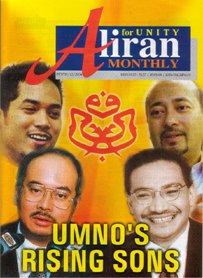
 In the long term, it is Najib Tun Razak, Hishamuddin Hussein, Mukhriz Mahathir and Khairy Jamaluddin who visibly represent the UMNO�s �Gen Next� leadership