
|
|||||||||||||||
|
COVER STORY
Towards a new politics of ideas?
We are in for an exciting new era
by Nik Nazmi Nik Ahmad
Please support our work by buying a copy of our print publication, Aliran Monthly, from your nearest news-stand. Better still take out a subscription now. If you prefer to read our web-based edition, please support our work and make a donation.
In 2004, a sense of renewal emerged in Malaysian politics after so long. Actually it began a little bit earlier, in October 2003, with the accession of Abdullah Ahmad Badawi as Prime Minister, replacing Dr. Mahathir Mohamad. Then this year, former deputy prime minister Anwar Ibrahim was acquitted from his sodomy conviction in a startling Federal Court decision. Although the same court subsequently rejected an appeal regarding his corruption conviction, which effectively bars Anwar from holding any political posts in the next four years, an Anwar outside the prison exerts more political influence than an Anwar inside. In the DAP, a one time long-serving Secretary General and recent Chairman, Lim Kit Siang (who is also the present Opposition Leader), has declined to hold any executive posts, paving the way for his colleague Karpal Singh to take over as DAP Chairman and Lim's son, Guan Eng, as Secretary General. These changes undoubtedly mean that Malaysian politics will have new variables to consider. Abdullah, Anwar and Guan Eng all have different styles and personalities compared with the old guard of Malaysian politics � Mahathir and Kit Siang. Mahathir and Kit Siang helmed a political era of intense rivalry and hardline politicking. The new personalities on the other hand seem to personify more open politics, with a human face. Abdullah has been the epitome of this, albeit at a rhetorical level. He and his young press-savvy advisors have worked hard to distance themselves from the extravagant past: the postponement of the double-tracking project; his anti-corruption rhetoric; a more Islamic approach; the release of Anwar; and the recent small-person�s budget. As the March election results proved, these went well with the new Malaysian electorate. Anwar too is not a dissimilar figure. His strength originates from his charisma, intellect and sophistication that charm both Malaysians and the international audience. His Islamic background combined with his mastery of international economics and politics underlie this. When he was deputy prime minister, Anwar too launched many projects for the poor and spoke of a more liberal civil society and an Asian Renaissance. Added to this is the potent pedigree of having been jailed twice, in the eyes of many Malaysians, for his ideals and principles. Anwar seems the personification of new politics. Then, of course, we have Guan Eng, the youngest of them all. He too earned his stripes through imprisonment. The reason for the jailing was that Guan Eng fought for the welfare of a Malay girl who was allegedly victimised by a top-level UMNO politician � and this, coupled with the DAP�s role in reformasi, has played down somewhat the DAP�s chauvinist Chinese image. In a party long dominated by the towering Kit Siang, Chen Man Hin and Karpal Singh; the charismatic Guan Eng (along with the younger Fong Po Kuan) seems to be proof that it is too early to dismiss the DAP just yet. Of course, just as each of them has strengths, they are not without their weaknesses in their claim for new politics. Both Abdullah and Anwar were UMNO leaders during the more illiberal days of Mahathir�s premiership. Anwar and Abdullah had the privilege of being the last two of Mahathir�s four deputies. The dark days of BMF, Maminco, Operasi Lalang and the judicial crisis stick out like a sore thumb. At the very least, Anwar and Abdullah are guilty by association. Guan Eng too cannot erase the talk of nepotism by virtue of being DAP supremo Kit Siang�s son. It didn�t help of course that the PAP in Singapore handed its leadership to Lee Hsieng Loong, the son of its own supremo, Lee Kuan Yew, at the same time. Therefore the image of a DAP being a highly regimented party that purges anyone seen as threatening Kit Siang�s hegemony has not been totally erased. Nevertheless, it is impossible for anyone to be perfect, what more politicians. If Abdullah, Anwar and Guan Eng are willing to focus on forging a new political discourse and opening up Malaysia�s democratic space, we are in for an exciting new era. All three in varying tones have spoken of a need for a united Malaysia and a shift from the politics of racial exclusivity; what we need is such a commitment not to be diluted by communalism when it comes to facing their respective ethnic audiences. Unfortunately, history has borne witness to many politicians who came to power with the promise of new politics, but faltered when they were put to the ultimate test that power presents. In the long run, the survival of Malaysian democracy depends on a viable two party system being put in place. The sacking of Anwar in 1998 spurred such a move in 1999 � yet a lack of leadership and selfish interests killed off the opposition�s effort. Nevertheless, just as we saw Semangat 46�s two-pronged coalition (Gagasan Rakyat with DAP and PBS, and Angkatan Perpaduan Ummah with PAS and some PAS splinter parties) in 1990 evolve into full alliance between PAS and DAP (along with Keadilan and PRM) in Barisan Alternatif in 1999; we hope that the next step is an intellectually coherent and stable opposition front in the near future. Guan Eng and Anwar will have major roles to play in shaping such a coalition. An important caveat is that this essay focuses heavily on personalities. In the words of �Malaysia�s most powerful 28-year old� and Abdullah�s son-in-law, Khairy Jamaluddin, there should be a shift from the politics of personalities to the politics of ideas. It is important that ideas underpin new politics. But, whether we like it or not, personalities will still play an important role in articulating and debating those ideas. Let the battle for new politics begin.
Now e-mail us and tell us what you think. Your comments might be published in the Letters section of our print magazine, Aliran Monthly. | |||||||||||||||



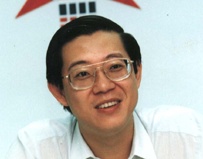
 These changes undoubtedly mean that Malaysian politics will have new variables to consider. Abdullah, Anwar and Guan Eng all have different styles and personalities compared with the old guard of Malaysian politics � Mahathir and Kit Siang.