
|
|||||||||||||||
|
HEART-TO-HEART
Picking up the pieces in Nanggroe Aceh Darussalam A tale of hope and inner strength amidst devastation
by Huang Li
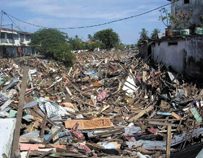
At Sukarnoe Hatta International Airport in Jakarta, I could see hundreds of relief workers of different nationalities on the same flight as mine, all travelling to the same destination, Banda Aceh. It was a grim reminder that I was on my way to a place that had just been hit by one of the worst disasters in a hundred years. On the flight, amidst the relief workers were a group of young Indonesians with 10 plastic bags of saplings. Later, I found out that these young guys were from the island of Sulawesi and the saplings were for their Acehnese relatives as a symbol of friendship and support in their loss. Unbelievable devastation Four hours later, the pilot informed us that we were approaching Banda Aceh and the tsunami damage could be seen from our windows. The bird�s eye view of the damage was just like the images I had seen on TV. The extent of the devastation was unbelievable. Twenty minutes later, the airstrip was finally ready for our Boeing 737 aircraft to land. At the chaotic airport of Banda Aceh, we were met by Aziz (not his real name), a sweet young man who was to be our supir (driver). He helped us track down our luggage. The conveyer belt of the airport had malfunctioned so we had to identify and carry our own luggage as it was unloaded from the aircraft. It was quite an experience and I did not feel any different from the tsunami survivors scurrying desperately to the helicopters that were bringing in food aid. On our way from the airport to the town proper, we drove past a mass grave where 6,000 victims had been laid to rest. I was in a daze but I kept up a lively conversation with Aziz. Apparently, he used to own an Internet caf�, which he had lost, along with his favourite sports car, to the killer waves. The Kijang van that he was driving (including the U2 CD that he was playing) was the only asset he now possessed to earn a living - by being a supir to one of the international organizations. It slowly dawned on me that Aceh was a land of wealth; even a young man his age could afford to own an Internet caf�. This was confirmed later when I saw the number and the size of beautiful houses around Banda Aceh. Rotting flesh One day, I was driven around the part of the town that was badly hit by the earthquake and the waves. It was surreal. I saw three-storey buildings reduced to two. I saw the thick-walled, barb-wired prison reduced to rubble and I wondered what had happened to the prisoners. Later, I read in the local newspaper that the government was offering lighter sentences and even pardons to surviving escaped prisoners who voluntarily turned themselves in. The streets were flooded with black muddy water and debris. So surreal was this view that the only thing that brought me back to reality was the smell of rotting human flesh. I was told that there was a difference between the smell of rotting human flesh and that of animal carcasses. I could not understand it until then. The stench was definitely different: eerily �sweet� and lingering. Despite being overwhelmed by the smell, as silly as it sounds, I did not cover my nose for fear of offending those who had perished and their surviving relatives. It was the least I could do to show my respect for the departed, I thought. The trip to the affected neighbourhoods was grimmer. Corpses lay in black plastic bags by the roadside, waiting to be picked up by lorries as they made their daily rounds before unloading the bodies at mass burial grounds. Clothes, mattresses, toys and praying mats were strewn all over, some caught in the branches of still-standing trees; evidence of how high the waves were. An Adidas shoe caught my eye and I wondered what happened to the owner and whether he or she survived the disaster. I saw the remains of a house - its floor and a battered refrigerator. What were the occupants doing or thinking about when the wave struck; did any of them survive, I wondered. Suddenly our supir stopped his car. He saw someone he recognized. He went over to shake his friend�s hand and they began exchanging stories as to who they knew had survived, who had not and where they were temporarily housed. It was a way for them to regain lost links; a common sight in Banda Aceh ever since the tsunami struck. I wondered if anyone could ever get used to that sort of emotional encounter. On our way back to our station, we drove past what used to be a playground that would have been filled with children�s laughter and cheerful squeals that dreadful Sunday morning. Nearby, I saw a pack of stray dogs that looked timid and wary. They seemed unscathed but they were equally scarred by the disaster. Inner strength Ironically, on the other side of Banda Aceh that was not hit by the wave (at least not physically), it was business as usual. Buffaloes grazed and egrets hunted for snails in the rice fields. It would have been hard to believe that this was also Banda Aceh if not for the overwhelming presence of foreign military trucks, international organizations and NGOs. Once in a while, the breeze would carry with it a solemn and lingering reminder of the departed still trapped under the rubble. My teammates and I were sent to Banda Aceh as part of the United Nations� relief team assigned to help in capacity building of a government office that had lost almost half of its staff members to the disaster. Throughout my assignment in Banda Aceh, I encountered many people, all with different faces and masks. Some tried to be heroes, some aspired to be stars, some were opportunistic and yet some were genuine. What touched me the most were the survivors. Most of the staff members who worked with me at our workstation were not untouched by the tsunami. Bapak Harun lost his wife who was home alone when he brought his two children out for a haircut. �There is no use to cry. Crying won�t bring her back. I have to keep living for my children�s sake�. Bapak Rahman became the sole survivor in his family of five when a wave tossed him out of the water and onto a tree. Ibu Yati lost a daughter when the baby was torn out of her grip by the sheer force of the water. �I might have lost a child but I have four others to take care of and we need to bring food to the table,� she said, revealing a deep inner strength. Many of them had lost their homes while some still had their houses standing but with debris and bodies trapped inside. On the second day of my assignment, Bapak Yanto came to us, complaining: �People keep coming to our office to assess the damage of our office but they never ask how we, the staff members, cope with life and whether we have anything to eat or not�. Only then did I realise that aid had not reached some of the neediest ones. I immediately made some phone calls to a list of NGOs that one of my teammates had brought with her. I finally got through to an NGO, the Jesuit Refugee Service, and told them of the situation. I was given an address. I later told my Acehnese friends about the existence of this NGO at the given address and that they should go to the office. They asked me to write a note to the person in charge at the NGO, which I did together with my contact number. That afternoon, we were called for a meeting in another office. When we came back a few hours later, lo and behold, there was food on the table and bags of rice and boxes of water and biscuits. Everybody went home that day with a full stomach and some provisions. Each day when I saw them, I could feel their grief. I could feel their guilt for not having been able to save their loved ones and others around them. Bapak Hamdan shared his experience of wading through waist-high muddy water while escaping to safety with his family and his helplessness at being unable to rescue those crying out for help under the rubble. Contrary to the impression that I had of Aceh being a male-dominated society, I noticed the women were the real pillars of strength. Most of the weight was carried by the women, at least in the office we were stationed in. The women were the ones who got things organized in the office. They were the ones who gathered the drenched books and files that fell into the muddy water to dry. Also contrary to the impression that I had earlier, the men, I noticed, were relaxed in the presence of women who had not covered their heads. They were definitely more relaxed than most Malaysian Muslim men. Smiles, hope and resilience And yet, despite these painful experiences, they still managed to smile. Despite not knowing what they would wear and how their growling stomachs would be fed the next day, they courageously faced the morrow. Despite not knowing where they would sleep each night, they still managed to appear at their workplace each morning. Banda Aceh might have lost almost half of its population, but its survivors had not lost hope, their will to survive or their determination to rebuild their homeland. Aziz, our supir, told us: �I want to get married to my girlfriend as soon as possible so that I can start a family and rebuild Aceh�. How could anyone not be humbled by the strength of the Acehnese? This strength, I suspect, was developed over the decades of political struggle between them and the Indonesian government. The Acehnese, I found, were a sincere, honest, genuine and generally God-fearing bunch. Interestingly, the men generally preferred their cigarettes to real food. Once I asked a man for a favour and told him to spend the remaining money that I gave him on some food or other necessities for himself. I later found out he had spent the money on a pack of cigarettes and returned the remaining money to me. Indeed, these beautiful people never ceased to amaze and amuse me. Still, it was not easy listening to their stories without being touched. The friendship that was built over the period of my assignment at Banda Aceh went deeper than anyone could imagine. It was a friendship built on pure humanity. That friendship, they said, was a consolation to them, a reminder that they were not alone in this �great test from God.� The day before I left Banda Aceh, I noticed there were shoots sprouting from the trees that seemed to be dying due to the potent brackish water; a sign of hope and resilience in this tortured land. As I waited to check in at the airport, I saw a young girl clad in a T-shirt and a towel coming out from the bathroom - must be one of the IDPs (Internally Displaced People) from one of the camps near the airport, I thought. How long more would she have to make do with a public restroom until she found a real home. I left Nanggroe Aceh Darussalam still in a daze. I had seen and felt so much in 11 days that I could not make sense of everything. These poignant moments and memories are a solemn reminder of how fragile life is; ironically too, they have also revealed how resilient life can be. It will take me a while to digest everything. My only wish is that my short presence in the land of hope has touched my Acehnese friends, for they have touched me profoundly with the remaining inner strength they have. Please support our work by buying a copy of our print publication, Aliran Monthly, from your nearest news-stand. Better still take out a subscription now. If you prefer to read our web-based edition, please support our work and make a donation.
Now e-mail us and tell us what you think. Your comments might be published in the Letters section of our print magazine, Aliran Monthly. | |||||||||||||||

 I want to get married to my girlfriend as soon as possible so that I can start a family and rebuild Aceh.
