
|
|||||||||||||||
|
INTER-RELIGIOUS DIALOGUE
Faultlines of Malaysian multiculturalism I urge my fellow Muslims to rethink their objections to the Inter-faith Commission
by Johan Abdullah
How have our ethnic cleavages been overtaken by our religious cleavages? A brief rendering of the history of ethnic relations may help to show this. Whether one finds it palatable or not, a so-called �ethnic bargain� laid down the foundations of Malaysian ethnic relations under the shadow of Malay supremacy (ketuanan Melayu). This happened way back in 1957. Much water has flowed under the proverbial bridge since then, and that inter-ethnic bridge of sorts has survived (barely) the ethnic riots in 1964 in Singapore and Bukit Mertajam, the �hartal� riots of Penang in 1967 and most infamously the May 13 riots of 1969 in Kuala Lumpur. This self-same bridge has held despite the simmering tensions of 1987, the Kampong Rawa incident of 1998 and the Kampong Medan fracas of 2001. And somehow, even Malay supremacy, a metaphor for the reality of the preponderant political power of the Malays, has become �normalised� and is not greatly challenged these days. Uglier contestations But in more recent times a new �spectre� is haunting social relations � religion. The DAP, for example, has focused more in recent years on the �Islamic state� than on any other political issue. I would guess that the general public at large is also divided most conspicuously over such an issue, less so than say, education. The Islamic state issue was the wedge that drove the Barisan Alternatif to its state of virtual collapse today. The cleavage of faith has surfaced menacingly again in recent months in a more general sort of way with the controversy over the ICM. But first, it should be stated at the outset that the very idea of mooting an inter-faith commission is remarkable. I know of few countries in the world (if any) that have one. But then most things in Malaysia from the serious to the mundane tend to be rather remarkable � and I say this with no irony. For one, this polyglot country was given little chance by political scientists of surviving and yet it has hung together for almost five decades as an independent state, with few of the fissiparous tendencies that inflict other ethnically polarized countries. And after the September 11 event and its repercussions, Malaysia amazingly has remained an oasis of calmness and stability in the face of outbursts of political violence in the neighbouring states of Indonesia, the Philipiines and Thailand. But let�s not get complacent! Increasingly, there is more and more that is irksome and unsavoury in our faithlines. The contestations are becoming uglier. Recently, for example, the Persatuan Ulama Malaysia called on the Conference of Rulers to censure some individuals who were thought to have insulted Islam. We have coped with controversies over vernacular schooling, the Merdeka University, lion dance licenses, Kuan Yin statues, �Vision Schools�, etc, but can we deal sensibly with the faultlines of our faiths? It is commonplace in this country that we are never quite able to lay down the rules of the game for making social and political decisions. Sometimes the goal-posts get shifted in the middle of a game. Contestations sometimes end in a bargain, a compromise, or a negotiated resolution, which is well and good, but more often than not �solutions� are increasingly being imposed from the top-down. True, those who dabble in conflict resolution and management techniques may think we are a fine specimen of brinksmanship but for how long can we stay on shifting sand and not have proper rules-based systems for resolving cultural conflicts as we reach the end of the fifth decade of Merdeka? Somehow I feel such the current modus operandi of conflict resolution has reached its upper limits especially when it comes to matters of religion. It won�t be long before it fails in a comprehensive sort of way and as responsible citizens, we must ask for something more formal, effective and efficient to deal with our cultural fissures and most of all, our faithlines. Islamic credentials So now let me return to the issue of the ICM controversy. In my view, it hinged around the issue of Islam as the state or official religion, that is as the recognized primus inter pares of faiths in this country, much like ketuanan Melayu. But is there anyone who really doubts that to be the case? Very briefly, the predominant Islamic credentials of the Malaysian state, which have been well-established over time, are as follows:
I would contend that in a multicultural society all cultural and religious communities have the inalienable right to practice their own faiths free of interference from outsiders insofar as they adhere to the constitutional provisions of the state and the universal practice of the rule of law. Distinct groups such the Orang Asli and cultural minorities in Sarawak and Sabah may even argue that their customary practices should be equally and fully respected and preserved insofar as they don�t offend the established rule of law and the Constitution. Remarkable achievement In any multicultural society or state, the problem arises when boundaries are traversed deliberately or inadvertently. Here is where we need to have clear rules and laws which define what can or cannot be acceptable behaviour. We can choose to endlessly contest each and everything that crops up or we can, in a civilized way, establish some ground rules. I thought that was what the ICM was attempting to do. And, reading the lucid explanations of its spokesperson and steering committee chairman, Malik Imtiaz Sarwar, I had few doubts that this was the case. However, different views were apparently expressed by a number of Muslim groups. So let me briefly recount my understanding of the episode to shed more light on the matter. Some two years ago members of the human rights subcommittee of the Bar Council mooted the idea of an inter-faith commission. Some advocates of the idea, which included enlightened Muslims, felt that the existing inter-faith dialogue mechanism, the Malaysian Consultative Council for Buddhism, Christianity, Hinduism and Sikhism (MCCBCHS) was inadequate to deal with all inter-faith matters not least of all because Muslims were not members of the MCCBCHS. Indeed Muslim groups partook of no formal inter-faith mechanisms. Hence the idea of the ICM came about. All religious groups, and especially Muslim groups, were invited to participate in this Bar Council initiative. The Bar Council, incidentally, was at the time and led by a Muslim lawyer, Khutubul Zaman Bukhari. The long and short of it was that eventually after many meetings a broad consensus was arrived at to a national conference to moot the setting up of an ICM. It should be said that right from the outset some Muslim groups were not overly enthusiastic about the idea but no strong objection was registered. Indeed, groups like ABIM participated in the early decision-making. The Sisters-in Islam continue to support the idea. Thus, the conference objective, among other things, was to iron out differences and reassure doubters about the bona fide intentions and the value of having such a commission. As I said earlier, the holding of the conference, involving some 200 multi-faith participants, representing various faiths, was itself a remarkable achievement. It was also quite heartening that a minister, Rais Yatim, officiated at the event. Unsavoury twist But the inevitable happened. A coalition of 13 Muslim groups calling itself the Allied Coordinating Committee of Islamic NGOs (ACCIN) demanded that the government scuttle the idea of the ICM. The spokesperson of ACCIN, Mustapha Ma, made statements to the effect that there was deep hatred against Islam among some of the proponents of the ICM idea. He also reportedly remarked: �It was said that Malaysia would have achieved Islamic state status if not for the interference of the colonial masters and the arrival of non-Muslims. Are we now witnessing the regression of our country into a secular state with Islam as a mere ornament?� (Malaysiakini.com, March 1, 2005). It is a supreme irony and rather sad that the very idea of an inter-faith commission has turned out to be an issue requiring the eventual intervention of politicians and the prime minister no less. The boldness and inaccuracy of the ACCIN spokesperson�s remark may be attributed to the fact that the previous prime minister proclaimed Malaysia to be already an Islamic state although in actual fact the Malaysian constitution only states that Islam is the state religion. In point of fact, the Malaysian state remains one not based on any particular religion but one that guarantees freedoms of all faiths. In essence, Malaysia is and remains a multicultural state, not an Islamic state. The whole unsavoury twist in this saga actually shows that an ICM mechanism is very much needed in Malaysia�s multicultural society. ACCIN spokesperson�s statement would be the very sort of insensitivity that needs to be addressed. I don�t also doubt that there are also much unspoken cultural insensitivities on the part of non-Muslims towards Muslims, which we hear of on an everyday basis, but no one is so bold as to express them publicly like the ACCIN spokesperson. A pertinent point is why should the Muslim majority in particular feel insecure about the practice of its faith as expressed by such opinions as that of ACCIN? By all accounts, time and demography are on the Muslims� side; the 55 percent or more of Muslims will in time become an overwhelming two-thirds majority Disturbing withdrawal What I also found disturbing in this episode was the withdrawal of groups like ABIM and the International Movement for a Just World from participation in the ICM conference. If supposedly progressive NGOs in the country find it difficult to support an idea as important as an inter-faith commission, then it is little wonder that we can have opinions such as that of Mustapha Ma. The Muslim fringe of Malaysia - are now determining Islam�s discourse. The open-mindedness and generosity of Muslims is what this country needs, not the narrow-mindedness and bigotry led by an extreme fringe of Muslim champions who are driven by a false sense of insecurity to use Islam for their own narrow politics. Writing as a Muslim I have absolutely no problem with an ICM which lays down, even if necessary, the legal niceties for inter-religious relations in Malaysia�s multicultural society. As the great Muslim jurist Ibn Khaldun has taught us, law is humanity�s most civilized manner of resolving conflicts. I would urge my fellow Muslims to re-think their objections to the ICM. Please support our work by buying a copy of our print publication, Aliran Monthly, from your nearest news-stand. Better still take out a subscription now. If you prefer to read our web-based edition, please support our work and make a donation. Now tell us what you think in fewer than 250 words. Your comments may be published in the Letters section of our print magazine, Aliran Monthly. | |||||||||||||||

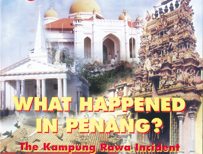
 This self-same (inter-ethnic) bridge has held despite the simmering tensions of 1987, the Kampong Rawa incident of 1998 and the Kampong Medan fracas of 2001.
