
|
|||||||||||||||
|
ENVIRONMENT
Earth: The final frontier for human rights (Part 1) A global environmental crisis is unfolding before our very eyes
by Angeline Loh
Most of us would conclude that we are reasonably happy as long as life remains routine and we don�t lack what we take for granted. In our nice little cocoons we�re cozy. In our beloved country, Malaysia, we like to think we live apparently carefree lives. Yet something rather disturbing seems to be happening. We acknowledge that life is changing, but in some ways for the worse. This subtle but inevitable change is beginning to erode the ground beneath our feet. Cracks are appearing in our cozy cocoons. Ugly issues now necessarily break into our consciousness. Things we prefer not to think about - such as the mud-coloured water from the tap that we have to drink or shower with; the rust-coloured water with which we have to cook our food, wash our pans and plates and do our laundry. So we have to get expensive filter systems fixed to the water supply. Isn�t it our right to have clean water? For all the rhetoric spewed in the press by water authorities, nothing has changed. We still have to take our own precautions to feel safe; so we pay for extra gadgets. Stepping out for a breath of fresh air? What fresh air? At six in the morning, the whiff of traffic fumes already permeates the atmosphere. We can see the air we breathe as we cross the road holding our hands over our noses - a natural reflex but a futile attempt to try and lessen the amount of smog we inhale. We have learnt to expect the �haze season� every year and blame it on neighbouring countries, forgetting our own callous attitude towards environmental issues. Time to buy face masks, and more money pours out. Industries that catered for special needs in the past have now boomed as their products become necessities. Pollution, like war, is a money spinner. Funny how these negative occurrences become acceptable in our psyche. We continue our lifestyles of waste as if there were no tomorrow. "Prophets of doom" ignored We fail to ask ourselves if we, human beings living on this planet, our only home, have a right to a habitable, unpolluted environment? Frequently, we prefer to pretend that no cracks exist in our badly maintained houses even if we know the house will ultimately crumble despite our useless efforts to hide the defects. Governments' attempts to conserve the natural environment have been minimal, piece meal, contradictory and ineffective. Economic considerations take priority as we speed towards achieving �developed nation� status. Protests and warnings by conservationists and environmental NGOs have been badly received or ingored in the past, like water off a duck�s back. They were labeled �prophets of doom� and ridiculed by the media, whose prejudice has been fed by their vested interests in receiving corporate advertising. The warnings came decades ago. Like the story of �Noah�s Ark�, only a few recognized the signs of looming disaster. When the flood that destroyed the earth did inevitably come, it must have been too late for regret. The world is no longer a place so large or mysterious today as it was perceived to be by medieval folk who thought it flat with edges over which a ship could fall into the unknown. Language has evolved to identify and describe the state of our planet. You don�t have to be a rocket scientist to come across words like, �global warming�, �climate change�, �rising sea levels,� �acid rain�, �green house gases�, �toxic wastes� and �nuclear fallout�. Even the illiterate are not ignorant or unfamiliar with the changes in their surrounding environment - changes they had never witnessed before. The simple fisherfolk can tell why making a living is becoming increasingly difficult, why the tides don�t come in as they used to or why there are fewer fish where once supply was abundant. They are fully aware of climate change and pollution. These simple observations are more significant than many of us realise with repercussions on society far beyond the fishing village. Rising sea level At the 59th United Nations general assembly meeting in New York this year, the small island nations in the Pacific basin and the Caribbean begged the international community to consider climate change and rising sea levels resulting from global warming as urgent a threat as terrorism. They desperately urged countries to ratify the Kyoto Protocol on global warming. President Anote Tong of Kiribati (one of the island states most threatened by rising sea levels) said, �We have demonstrated remarkable solidarity in the fight against global terrorism. Can we not demonstrate the same in the fight against climate change and sea level rise?� The situation is of desperate urgency for these low-lying island nations. Amongst them, besides Kiribati, were St. Vincent and the Grenadines, Haiti, St. Kitts Nevis, Grenada and other Pacific islands, one of which is Sao Tome and Principe in the Gulf of Guinea. Its president, Fradique de Menezes, said, �Sao Tome and Principe continues to see our very existence threatened by global warming.� He feared his country would be reduced to �nothing but a tiny volcanic peak sticking above the waves.� In view of recent natural hurricane disasters that have struck island states such as Haiti and Grenada and coastal areas of the United States, people everywhere must appreciate that global warming is a serious problem. We must urge our governments to ratify the 1997 Kyoto Protocol and other international environmental treaties to conserve our planet. More significantly, we must re-examine our present lifestyles, values and development programmes and technologies. Eco-friendly economics needed The 1997 Kyoto Protocol is only one of the many international treaties devised to protect our planet�s environment. Under its terms, industrialized nations should decrease their collective emissions of six major greenhouse gases to 5.2 percent below 1990 levels by the year 2012 to �slow global warming�. Russia, one of the foremost member states of the United Nations, has very recently ratified the Kyoto Protocol, enabling enforcement of this agreement on 16 February 2005. In contrast, the United States has unequivocally rejected support for this treaty on the grounds that it �puts a disproportionate burden on the American economy and favours developing nations.� It is interesting to note that the United States explicitly admits that it only pays lip-service to alleviation of poverty and leaves the world in no doubt that the US Government only looks after its own vested interests. For all the hype in its calls to the international community to fight terrorism, it is unwilling to concede even conditionally to measures that would more equally distribute global economic wealth and conserve world resources. The Guardian, UK, in a reported on 12 September 2004 under the headline, �US Declines to Back Poverty Declaration,� US objections to proposed international taxes alleging �they would be inherently undemocratic and impossible to implement.� President Bush was seen to have �skipped� two high-level meetings discussing the issue. Kenya�s Nobel Peace Prize winner, environmentalist Dr. Wangari Maathai, added her voice to calls urging wealthy developed nations to ratify the Kyoto Protocol. �We continue to appeal to the rich countries in the world to consider patterns of lifestyle that can reduce pollution of the environment.� She added, � I would like to see America not sacrifice the global environment because they have a lifestyle they must maintain.� The United States, the world�s leading polluter, and the two other large polluter nations, China and Australia, have not yet ratified the 1997 Protocol. Their main objection: economic reasons. But wouldn�t more eco-friendly economics be just as viable as the current eco-unfriendly economics? A catastrophic acceleration On 11 October 2004, Reuters environmental correspondent, Alister Doyle, reported that scientists were saying, �An unexplained jump in greenhouse gases since 2002 might herald a catastrophic acceleration of global warming if it becomes a trend.� Confirming this, Richard Betts, Manager for Ecosystems and Climate impact at the Hadley Centre, UK, explained that carbon dioxide (CO2) levels had risen faster than average over two years. CO2 is the main greenhouse gas causing rises in global temperature since the Industrial Revolution. Although scientists declined to be �alarmist�, they admitted that �figures were confirmed at sites including Mauna Loa, Hawaii, west Ireland� and �the Norwegian Arctic island of Svalbard, about 1,300km from the North Pole� in the northern hemisphere. This two-year increase in greenhouse gases is found to be faster than UN projections until 2100 based on the burning of fossil fuels. Higher global temperatures could spark off �everything from desertification to rising sea levels.� Scientists estimate a reduction of at least 70% of greenhouse gas emissions over the present century is essential to limit the effects of climate change such as the recent chaotic weather occurrences (hurricanes), flooding and rising sea levels resulting in steady shoreline erosion and the submergence of low-lying islands. CNN.com reported on 2 November 2004 that �A thaw of the Arctic icecap is accelerating because of global warming�due to a build up of heat-trapping gases and the trend is set to continue�. The Arctic Climate Impact Assessment (ACIA) report confirms that gas emissions from cars, factories and power plants are major sources of greenhouse gases. The urgency of the situation has forced Arctic-rim nations comprising the United States, Russia, Canada, Denmark, Norway, Sweden, Finland and Iceland to take some kind of action. Regrettably, they remain in disagreement, with the US refusing to take any drastic measures to alleviate the crisis. Devastation and destruction is widespread. The massive loss of human life is tragic, and the resulting homelessness of thousands has contributed to a worsening global humanitarian crisis.
Please support our work by buying a copy of our print publication, Aliran Monthly, from your nearest news-stand. Better still take out a subscription now. If you prefer to read our web-based edition, please support our work and make a donation. Now tell us what you think in fewer than 250 words. Your comments may be published in the Letters section of our print magazine, Aliran Monthly. | |||||||||||||||

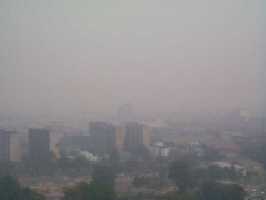
 We have learnt to expect the �haze season� every year and blame it on neighbouring countries, forgetting our own callous attitude towards environmental issues.
