by Koon Yew Yin
Aliran Monthly Vol 25 (2005): Issue 4
I wish to present an idea which the Government can develop to solve the diesel problem and save the country about RM2 billion per year.
The idea is based on increasing the proportion of diesel passenger cars used in Malaysia. In Europe, about 50 per cent of vehicles currently sold use diesel. In France and Belgium, that figure is even higher at 67 per cent and in Austria it is over 71 per cent. There will be more and more diesel cars as time goes by. Europe�s diesel car share is predicted to jump to significantly higher levels by 2009, to the point where the vast majority of new cars sold in Europe will be diesel powered.
Why dieseled-powered cars?
There are several contributory reasons why the use of diesel-powered cars has risen at such a rate. These are as follows:
- Much better fuel economy - The diesel engine is the most fuel efficient of all internal combustion engines and consumes 30-60 per cent less fuel than petrol-powered cars
- Cleaner engines which produce less harmful gases (such as carbon monoxide, hydrocarbon and carbon dioxide) - 25% less than petrol-powered cars, which also produce particulate matter and nitrogen oxides (The reason we see so much black smoke churned out by lorries, buses and taxies on the road is that these vehicles are too old and under the law these old vehicles should not be allowed to run any longer. Obviously the controlling officers are not doing their duty. Besides, most of the smoky taxies are using petrol and not diesel.)
- Significantly improved driveability and performance due to recent advances in diesel technology. This translates to far better overtaking and acceleration figures, making them even more attractive to drivers. Superior engine torque at lower engine speeds also results in reduced noise levels
- Diesel engines are far more durable and are cheaper to maintain
Diesel fuel itself has many attributes that make it such an effective source of power.
These include:
- Safety - Diesel is a safer fuel than gasoline or other alternatives. It is less flammable and explosive than gasoline.
- Energy content - Diesel contains about 30 per cent more energy per gallon than gasoline
- Performance - Diesel has a greater power density than other fuels: it packs more power per unit volume than other fuels
These are some of the well-established reasons why so many European consumers choose diesel engines over petrol. We Malaysians should realise the potential in the modern diesel engine and act now to take advantage of its benefits.
Diesel vs Petrol: Another view
Diesels are slightly better than petrol-driven vehicles as regards effects on the climate, but much worse in the way of emissions of NOx, parti-culates, and carcinogenic substances .
While diesels consume 20-25 per cent less fuel than petrol-driven types, burning a litre of diesel fuel gives rise to 15 per cent more carbon dioxide than burning of a litre of petrol does. The emissions of this greenhouse gas are thus only marginally better from diesels. An increase from 1 to 20 per cent in the proportion of diesels among the new cars sold would mean an overall reduction of no more than 1-2 per cent in the emissions of carbon dioxide from such vehicles. The emissions of nitrogen oxides and particulates would on the other hand be two and two-and-a-half times greater, respectively.
In comparison with a diesel, a modern petrol-driven vehicle poses far less danger as regards the cancer risk, effects on the respiratory system, and the possibility of causing acute illness. The emissions from modern diesel vehicles are estimated to be 3-4 time more carcinogenic than those from the petrol-driven type. The emissions of particulates are also 10-15 times greater even from modern diesels although, as the EPA report admits, the new diesels are very much better than the old.
But as Reino Abrahamsson says: Everyone thinking of buying a new car should go for a fuel-efficient petrol-driven one rather than a diesel.
Source: acidrain.org
|
Illogical pricing systems
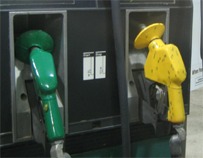
Unfortunately, our present road tax structure in Malaysia is set at a level that penalises the owning of a diesel car. Diesel passenger car owners have to pay 400 per cent more than the equivalent petrol car for road tax. On the other hand, the import duty for diesel passenger cars is lower than the import duty for all petrol passenger cars. Diesel sold at the pumps is cheaper than petrol. Diesel for industries, which we should encourage, costs about double the price of that for motor vehicles. That is why there is so much of smuggling; as a result, all the pumps are always short of diesel for sale. All these illogical pricing systems need immediate overhaul.
In Europe, road taxes for diesel and passenger cars vary only slightly and the prices for diesel and petrol are about the same. A structure similar to this would encourage Malaysians to buy diesel cars and avoid all this confusion.
Huge savings
Now, let us look into the potential savings that can be achieved. In the last three years - from 2002 to 2004 - over 1,300,000 new passenger vehicles were purchased in Malaysia.
If we assume the following:
- the total number of vehicles on the road is about 2.6 million,
- half of them are using diesel,
- the average running cost for fuel is about RM300 per vehicle/month
- the saving using diesel is about 40 per cent
the total saving per year works out to RM1.87 billion. This is a recurring annual saving.
The impact to our economy and environment would be huge due to lower consumption of our country�s oil reserves and reduce emissions of harmful gases into the atmosphere. Moreover, we can earn foreign exchange by exporting the fuel we saved.
I trust the Government will quickly solve the diesel problem, overhaul all the illogical pricing systems and gain about RM2 billion annually.
Please support our work by buying a copy of our print publication,
Aliran Monthly, from your nearest news-stand. Better still take out a
subscription now. If you prefer to read our web-based edition, please support our work and
make a donation.
Chartered civil engineer Koon Yew Yin, 72, is a founder director of IJM Corporation Bhd and former member of the Board of Engineers, Malaysia, a statutory body to regulate the engineering profession.
|
Now tell us what you think in fewer than 250 words. Your comments may be published in the Letters section of our print magazine,
Aliran Monthly.


 All these illogical pricing systems need immediate overhaul.
