by Ramdas Tikamdas
Aliran Monthly Vol 25 (2005): Issue 5
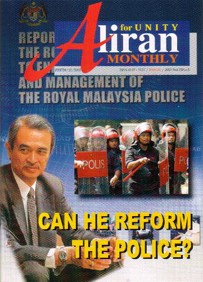
The Royal Commission entrusted with the duty to inquire into and make recommendations in respect of the police force has completed its task by preparing its comprehensive and far-reaching report.
The report identifies three major challenges, which in fact were the cause of serious public concern that led to the establishment of the Commission itself. These are:
- The high incidence of crime and widespread public apprehension regarding safety.
- Public perception of widespread corruption within the police force.
- Extensive and consistent abuse of human rights and non-compliance with prescribed laws.
The report acknowledges that the consequence of these three challenges is that there is a breakdown of public trust and confidence in the police force which is �generally viewed as inefficient, uncaring, unable to prevent or check crime.� It added that �infringements of human rights are extensive and PDRM is not seen as being transparent or accountable to the public.� (page 179)
The Commission carried out an indepth study of the inadequacies and weaknesses of the force and rightly observes that this study is a prerequisite for improvements to be proposed. Its Mission Statement is most forward-looking and in line with good governance in a democracy:
�To TRANSFORM the Royal Malaysia Police into a World Class, twenty-first century organisation that is efficient, clean and trustworthy, dedicated to serving the people and the nation with integrity and respect for human rights.�
This is the goal, but first the present reality: the problem of endemic corruption and abuse of power are identified as the double-headed hydra which is the enemy that has to be fought as tenaciously as the Royal Malaysia Police fought the Communist insurgents to protect our peace and stability. On corruption, the report (page 290) states:
�The War against corruption must be accorded the highest priority. This is because corruption is believed to be extensive, deep rooted and systemic. Political will rather than rhetoric is a prerequisite.
�
And on page 296:
�The drive against corruption cannot be targeted at the police alone. It must be targeted at the entire public service. The war against corruption must cover society at large too, because the givers reside within its fold.�
On abuse of power, the report states (page 302):
�� there is extensive and recurrent abuse of various kinds. They include applications by the police for the maximum remand period for suspects under the CPC with little attempt made to complete investigations as soon as possible; serial remands; failure to hold inquests in cases of custodial death (only 6 inquests held on 80 custodial deaths from 2001 to 2004)�; and numerous denials of access to counsel on the grounds that it would interfere with investigations. They all add up to a pattern of consistent neglect and abuse of rights which appears to have become ingrained in police practices ��
And on page 128, the report states that the implementation by the police of the law relating to freedom of speech, assembly and association is in contravention with the fundamental liberties accorded by the Federal Constitution.
Basically these findings, expressed in sharp and transparent language, confirm what civil society groups have repeatedly stated. They have often said this in more temperate language, mindful of manoeuvring delicately through the veritable land-mines of our laws, only to find themselves dismissed as trouble-makers or, worse, drawn into the long and elastic arms of the law.
As acknowledged in the report itself on page 122:
�More often than not criticism is met with denial, defensiveness or even more discouraging, a threat to investigate and charge the complainant of a false complaint report.�
Recommendations
The most significant aspect of the report is in the recommendations proposed to achieve the Mission Statement. There are 125 recommendations. One stands out for immediate implementation.
- Independent Police Complaints and Misconduct Commission (IPCMC)
This is the proposed external oversight body to be established pursuant to an Act of Parliament vested with the powers to receive and investigate complaints regarding alleged police misconduct and to impose sanctions against those found guilty of any misconduct.
- Proposed amendment to S. 117 CPC: Remand procedures
This recommendation provides for the current procedure for remand for a total period of 15 days and the practice of �arrest first, investigate later� to be reviewed. The proposal is to allow for remand for a maximum period of no more than seven days for an arrest without warrant and no more than 24 hours for an arrest with warrant. For an arrest without warrant, the police must apply to the Magistrate for further remand every 48 hours should it be necessary, giving reasons in each case. The detained person shall have access to a lawyer.
- Code of practice relating to the arrest and detention of persons
This proposed code of practice provides for an independent Custody Officer who shall be responsible for the welfare and custody of every detainee, procedures for police interview including tape recordings, video surveillance and access to lawyers.
- S. 113 CPC - Confessions
The Commission found that the present tendency is for police investigation to be not evidence�based but confession�based and this is open to abuse especially since the provision allows for the caution statement to be recorded by the police themselves. The Commission therefore recommends that S. 113 be repealed. In the meantime, before its repeal, the proposal is that the whole process of recording the statement of the accused must be tape-recorded or video-recorded in the presence of the accused�s counsel.
The Commission recommends that it would be better for all statements or confessions to be recorded by a Magistrate pursuant to S. 115 CPC. The accused person should also be given the right to be represented by his counsel when he makes the statement.
-
Inquiries into deaths in custody
The report views with grave concern the unacceptable high incidence of deaths in custody and the failure by the authorities to hold inquests before magistrates in most of the cases. The report recommends:
- The immediate family of the deceased to be informed and to be given sufficient time to be present at the post mortem.
- Inquiries must be held by a magistrate into all cases of death in custody within one month of receiving the report of death.
- Copies of all documents to be used as evidence in such an inquiry should be made available to the deceased�s family, who should be allowed to be present at the inquiry.
- S. 27 Police Act 1967 : Freedom of speech, assembly and association
The Commission�s reaffirmation of the principle that �democracy cannot survive nor can it thrive, without freedom of speech, assembly and association� is most commendable. The Report states that S. 27 of the Police Act 1967 is �bad law� and recommends that licences for peaceful assemblies in public places are to be given as a matter of course. Any refusal by the OCPD must be justified with reasons; and there must a right of appeal to the CPO whose refusal, if any, must also be justified with reasons. Further, if the OCPD does not reply to any application for the licecse within one week after the application is made, it shall be deemed that the licence is granted.
No licence is to be required for �any activity� in a private place and therefore S. 27A, 27B and 27C are to be repealed.
These recommendations have some merit. But it would have been better if the Commission had considered SUHAKAM�S Freedom of Assembly Report, which proposed amendments to the Police Act, Rules & Regulations �to require only notification to the Police on the part of the organisers, rather than application for permit to hold assemblies.�
- Internal Security Act
The Report recommends that the initial 60-day detention period under S. 73 of the ISA be amended to a 30-day detention period. Further, the arrested detainee is to be produced before a magistrate within 24 hours of arrest and is to be allowed access to family members and counsel within seven days of arrest. S. 8 of the ISA, which provides for subsequent ministerial detention of two-year periods indefinitely, continues.
The Commission�s recommendation is unsatisfactory as it legitimises preventive detention without trial. The report does not consider at all SUHAKAM�s recommendation, which accords a better balance between security and public order on the one hand and fundamental human rights principles on the other.
SUHAKAM has recommended that the ISA be repealed and replaced with a new comprehensive legislation, which deals with national security including terrorism. These special offences will be listed as scheduled offences. Under this proposed enactment, the police can detain a person for a maximum of 24 hours, after which the person must be produced before a High Court Judge. Pursuant to an order of the High Court, a person may be further detained for maximum periods of seven days each time for a maximum of 29 days. Upon the expiry of the 29 days, the person must either be released or charged in court for the scheduled offence. The legislation shall only be in force for a period of one year renewable for one-year periods by authority of Parliament. SUHAKAM's recommendation merits serious consideration by Parliament.
- Repeal of the Restricted Residence Act 1933 (RRA) and Emergency (Public Order And Prevention of Crime) Ordinances 1969 (EPOPCO)
The Report recommends that RRA be repealed because restricting residence is not practical and action can be taken under other laws. Likewise EPOPCO should be repealed because it has facilitated the abuse of fundamental liberties.
Omissions
The report also has some glaring omissions such as the issue of the high incidence of persons killed in police shootings. The report ought to have considered international standards for the use of fire-arms and provided a specific mechanism to deal with this problem.
Another serious omission was in not inquiring into the role and conduct of the police in responding to the Kampung Medan killings and brutal assaults.
Apart from these omissions, overall the report is comprehensive, courageous and lives up to its task in line with the Mission Statement.
The real test
The government ought to be commended in instituting the Royal Commission. Now that the report has been concluded, the real test is whether the government has the political will to implement the recommendations. The first real test would be whether the report is tabled and debated in the next parliamentary sitting in June for debate by the people�s representatives. Tabling the Bill for the establishment of the IPCMC would be a clear signal of the Government�s resolve to take the first step to achieve the Mission Statement expressed in the report.
The recommendations in the report, when implemented, will certainly mark a new chapter in the administration of justice, law enforcement and the rule of law in the country.
In this mission, the Government can expect the full cooperation and support of civil society.
Please support our work by buying a copy of our print publication,
Aliran Monthly, from your nearest news-stand. Better still take out a
subscription now. If you prefer to read our web-based edition, please support our work and
make a donation.
Ramdas Tikamdas, a lawyer, is the immediate past president of the Human Right Society of Malaysia (HAKAM) |
Now tell us what you think in fewer than 250 words. Your comments may be published in the Letters section of our print magazine,
Aliran Monthly.


 Now that the report has been concluded, the real test is whether the government has the political will to implement the recommendations.
