
|
|||||||||||||||
|
COVER STORY
Cakap tak serupa bikin It is time to act, not to conduct more studies Aliran Monthly Vol 25 (2005): Issue 5
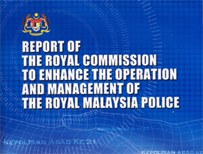
In its 433-page Report, the Commission headed by former Chief Justice, Tun Mohamed Dzaiddin Abdullah, has compiled a list of complaints and identified many of the critical problems that have contributed towards a widely perceived deterioration in the performance of the Police. This perception, in turn, has resulted in eroding public confidence in the Police. Many of these complaints about police high-handedness had been voiced previously - through the lodging of police reports and/or via submissions to Suhakam - by individuals, groups and organisations who had been victimized. The Bar Council, opposition parties and other critics had also rallied to the support of these aggrieved individuals/groups. Indeed, some of these complaints are contained in Suhakam�s Annual Reports, which unfortunately have not been deliberated upon in Parliament. The mainstream media too have been reluctant to report on, let alone investigate them. Thus, many of these complaints have not been highlighted or brought into the public domain previously. Thanks to the setting up of the Royal Commission by Abdullah Badawi in late 2004, shortly after his appointment as the new prime minister, these victims and support groups have been given a hearing. They have had the opportunity to voice their complaints during the Commission�s close-door hearings, resulting in their inclusion in the Royal Commission Report. Such a comprehensive listing of complaints against the guardians of law and order is unprecedented. Apart from the complaints, the Commission has made 125 recommendations and proposed time-lines for their implementation. Some 80 per cent are to be implemented by 2006, many of them even earlier. There were some glaring omissions though - the Report failed to focus on the allegedly indiscriminate shootings of criminal suspects; neither did it probe the tragic and bloody Kampong Medan killings nor call for the repeal of the repressive Internal Security Act (ISA). That said, the Report is a monumental and most welcome initiative towards improving the performance of the Police, resolving the problems of public security, and restoring confidence in our system of law and order. For Aliran - and for many other civil society groups - the Commission�s most important recommendation is the setting up of an Independent Police Complaints and Misconduct Commission to oversee the performance of the force. Accompanying this recommendation is a proposed bill that could be introduced in the next parliamentary session. We strongly recommend that the Executive take the necessary steps to do just that. Four main areas The Commission has outlined 10 �strategic thrusts� to revitalise the force. These may be grouped under four major areas. For Aliran, the three most critical areas are:
It is significant that we no longer hear or read in the dailies about this monumental Report so soon after its release. Indeed, public discussion of the Report and its 125 recommendations seemed to have stopped within a week after the release of the Report. On the first few days, all sectors of society appeared to have welcomed the Report and its findings. The prime minister himself called upon the public to �accept the report in a positive manner.� He announced that Cabinet had approved the formation of a task force - comprising senior officials from the Public Services Department, the Treasury, Attorney-General�s Chambers and the Internal Security Ministry - which he himself would head. Its task would be to decide on how best to carry out the 125 recommendations and to categorise them for immediate, medium and long-term implementation. Some recommendations, he said, were already being implemented. The deputy premier as well as other politicians � BN as well as the Opposition - also praised the work of the Commission while the Inspector-General of Police (IGP) described the Royal Commission Report as �fair and balanced.� Most dailies carried �Specials� on the contents of the Report while their top editors wrote commentaries in support of the Commission�s findings. �It�s time to act,� one opined, capturing the mood of the mainstream media in those early days. Various members of the Commission also remarked that they had been shocked by some of the public complaints. But they also reminded the public that other police personnel had displayed exemplary conduct and were friendly and helpful to the public. The deputy chair of the Commission, former IGP Mohd Hanif Omar, called for the setting up of �mini commissions or committees� to study and find ways to implement thoroughly the Commission�s recommendations. Touching a raw nerve? Perhaps it was the focus on corruption - in particular, the case of one former senior police officer who allegedly had declared assets totalling RM34 million, a revelation that prompted the deputy premier to call upon the police to look into the matter - that led to the the sudden downplaying of the Report. In fact, there was already some chatter on the Internet pointing out that corruption was not just confined to the police. Why not probe the bigger fish, including the corrupt politicians, as well? Or perhaps it was the public�s harping on the need, identified in the Royal Commission Report, to replace the existing core values of the Police as �law enforcers� with �a service paradigm� that triggered off the mainstream media�s marginalisation of the issue. It was as though some raw nerves had been touched. For the IGP clearly cautioned that �reforms must not override those core values.� �We wear uniforms and not ties when carrying out our duties,� he said. �We have to be disciplined on the job.� By the end of the week when the report was released, the newspapers were diverted into highlighting a story about the police identifying another militant group operating in the country - which turned out to be inaccurate after all. It was not a militant group but a deviant religious group, it seems. But by then, the Commission�s Report had all but disappeared from the mainstream media�s radar screen. Now that the popular call for Police reform has been muted, the fear is that many of the key recommendations - especially the need to wipe out corruption, to ensure that the police comply with laws and human rights obligations, and to combat crime systematically and seriously - might not receive the attention they deserve. Instead, the focus for reform might shift to implementing those recommendations on modernising the force, improving its remuneration system, and providing better equipment, housing and work premises. Recall the case of the Royal Commission of Inquiry into the Workings of Local Authorities in West Malaysia, the so-called Athi Nahappan Report, 1968. It, too, was an excellent piece of work and its members were roundly congratulated for a job well done. A special committee, however, was then appointed �to study the implications of the Commission�s recommendations.� This resulted in the reversal of several of the Commission�s major recommendations. Most notably, whereas the Athi Nahappan Report had called for the re-instatement of local government elections, the special committee recommended that these local elections, originally suspended because of Confrontation with Indonesia in 1965, be done away with! What's to be done? The people must stand up to remind the prime minister of his promise that the role of the task force is to study how to best implement the 125 recommendations. The Police force deserves improved housing, better premises, and better remuneration. But restoring public security, ensuring that that the law is upheld and human rights respected, and eliminating police corruption is of even greater urgency. The first step towards police reform would be the establishment of the Independent Police Complaints and Misconduct Commission. Respected citizens including retired judges, officials, religious leaders and members of human rights NGOs should be invited to sit on this body. Aliran proposes that civil society organisations also set up their own �People�s Task Force� to monitor the one headed by the PM. Its principal task is to remind the PM�s task force of the deadlines and to get on with implementation of the reforms. There is no need for further studies. No need even for more talk. It�s time to act. Cakap tak serupa bikin! Please support our work by buying a copy of our print publication, Aliran Monthly, from your nearest news-stand. Better still take out a subscription now. If you prefer to read our web-based edition, please support our work and make a donation. Now tell us what you think in fewer than 250 words. Your comments may be published in the Letters section of our print magazine, Aliran Monthly. | |||||||||||||||

 Perhaps it was the focus on corruption - in particular, the case of one former senior police officer who allegedly had declared assets totalling RM34 million, a revelation that prompted the deputy premier to call upon the police to look into the matter - that led to the the sudden downplaying of the Report.
