
|
|||||||||||||||
|
HEART-TO-HEART
City Cabs: Klang Valley Like all of us, taxi-drivers are human beings trying to earn a living to support loved ones
by Wong Soak Koon
What images do we have of taxi drivers? Quite often we see them as rude, cunning and unsavoury. They fiddle with the meter to make us pay more, so we are told; they drive in circles to get to a place instead of using the nearest route. But is this fair? Should we tar a whole group with the same black paint because of a few blackguards? If so, we are indulging in unjust demonising. Perhaps we also need to ask ourselves why it is so much easier to paint certain classes of people in society (usually those earning small or minimum incomes, those not in fashionable togs even if these are service uniforms, etc.) as potential trouble-makers, cheats and criminals. A blame culture I would like to recall Dr. John Hilley�s insightful article: �Putting Compassion Back into Politics� in Aliran Monthly (Vol.25 No.2). It reinforces my sense that the homogenising effect of market forces and the compassion-less commodification of public life has created � a blame culture which castigates those at the bottom as failed market competitors� (p.27). Hilley adds that there is a �creeping lack of empathy� or, worse than this, �a visceral hatred towards marginal groups�(p.28). In a world of competitive economic forces and market rules, taxi drivers may be deemed �marginal� by many. But the reality is that we need these figures to toil in order to oil the ever-churning wheels of our bourgeois pleasures and sustain our never-satisfied consumerism. Just think of the time when you needed to go to an important lunch meeting at that chic little boutique hotel. Unfortunately, the hotel has a lamentably small car park and you fear for your brand-name car (Gen III, Gen X or Gen-Something), which you won�t park in some back-lane somewhere. Voila! A taxi appears. What a relief! Struggles of cabbies As I ride in taxis I have often chatted with the gentlemen who drive them. Encik A, my regular taxi-person who drives me to many venues, has always been punctual. He may not be in the smart uniforms of limousine-drivers and he often sports a shadow of unshaven stubble on his chin but his dignity is intact. A feisty fellow with a colourful sense of humour, he eloquently reveals the struggles of cabbies who rent their cabs. Very few individual licences are given so nearly all cab drivers have to rent their vehicles from companies. Besides the daily rental of from RM45 to RM 50 (rates vary with companies and radio-call facilities), cabbies have to take care of gas, tyres, sundry repairs and payment for the tests required to evaluate the road-worthiness of taxis. And there are some cases where companies only buy third-party insurance so a taxi-driver has to bear the costs of damage to the vehicle if an accident should occur. The forthright Encik A describes the companies renting out taxis as �lintah darat� (leeches) who �sambil menyelam minum air� (roughly translated as �wanting to profit from all avenues�). He pictures the company directors sitting in air-conditioned offices getting rich (�duduk mengaut kekayaan dalam opis dengan air-con�). Mr S, another taxi-driver I have had the good fortune to meet, solves my mobility problems when Encik A cannot make it. On Fridays, Mr S would have some sacred ash on his forehead from his Friday prayers at the temple and his taxi would have the fragrance of jasmine garlands. On one occasion, Mr S arrived late (this has never happened). Apparently he had to wait almost an hour for gas at a Petronas station in Cheras. The queue stretched ahead of him and the poor man was sorely tested (no doubt the thought that time lost means diminished earnings was beating out a rhythm in his brains). I learnt that there is a monopoly so that cheap gas can only be obtained from a limited number of designated Petronas stations. Taxi-drivers who have to stop at least three times a day to pump gas must be spending hours lining up. I can imagine that at certain stations, for example, in Cheras and Jalan Klang Lama, other drivers would be cursing taxis for creating a jam or blocking the road with the queues but what choice does a cabby have? As for Mr S, I am glad he has the calming effect of temple prayers. Nonetheless it must be most trying to have to wait for gas and then be told when one gets to the pump that the gas has run out (this has happened to poor Mr S). SOCSO, EPF? I recall another instance when I was given yet another glimpse into a taxi-driver�s insecure life. I got into a taxi driven by a young man and we had gone a short distance when he turned and asked politely if he could stop to take a drink of water and have some biscuits. It turned out that he has had gastric problems for a while and was in fact operated on at the General Hospital, but he could not take a break because the rental on the taxi has to be paid. There is no such thing as medical leave. In addition, medical coverage, which many of us, especially those still working, take for granted is apparently not available to taxi-drivers. As the young taxi-driver told me, �Yow cheen seh, mo cheen pang� (roughly meaning, �I can afford to die but I can�t afford to be sick�). It made me sad to hear these words although I am very sure he didn�t need my pity. He was simply stating a fact. And yet it did make me wonder what, if any, safety net there is for sundry taxi-drivers who rent cabs? Are the standard benefits such as SOCSO and EPF simply meaningless acronyms with no connection to this group of people in our society? Taxi-drivers can also be subjected to certain arbitrary measures meted out by certain government departments. Recently The Star (9 April 2005) reported that the Road Transport Department (RTD) was taken to court by a taxi-driver whose licence was summarily revoked. The RTD refused to renew his road tax without calling for an explanation from him after receiving a complaint that he refused to pick a passenger. This smacks of �guilty before being proven innocent� or worse, since he was never given a chance to prove anything. As the judge who ruled in favour of the taxi-driver puts it, �The defendants failed to prove, on the balance of probability, that the plaintiff was served with a show-cause letter.� The wronged taxi-driver deserves our admiration for not taking the RTD�s high-handed actions sitting down. One wonders though how many other taxi-drivers gave up? Action was filed in 1997 and it was a long, long wait for justice to be served. The newspaper also reported that in the meantime, the plaintiff �became an odd-job labourer and later a petty trader to support his family.� We can read into these lines the weight of human suffering he himself, his wife, children and dependants must have had to bear. No better, no worse than us Like all of us, taxi-drivers are human beings trying to earn a living to support loved ones. They are quite ordinary folks and are emphatically not like the larger-than-life figure of an American cabby portrayed by Robert de Niro in the famous movie. That film created the myth of a darkly heroic figure out of a taxi-driver who rescues a nubile Jodie Foster from a life of vice by taking the law into his own hands. Taxi-drivers are in fact no better and no worse than the rest of us. Unlike most of us, they are particularly vulnerable. Don�t forget taxi-drivers were themselves terrorised by the likes of �Cheras Appu�, the bogus taxi-driver who robbed many cabbies of their vehicles at knifepoint (The Star, 3 May 2005). Driving a taxi is a tough way to make a living. For many taxi-drivers the day starts with the first light of dawn (for some as early as 5 a.m.) and ends way past midnight. Thus, I wish them safe journeys as they ply the streets and lanes in the many townships that dot the Klang Valley. Please support our work by buying a copy of our print publication, Aliran Monthly, from your nearest news-stand. Better still take out a subscription now. If you prefer to read our web-based edition, please support our work and make a donation. Now tell us what you think in fewer than 250 words. Your comments may be published in the Letters section of our print magazine, Aliran Monthly. | |||||||||||||||

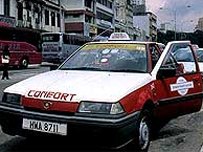
 Driving a taxi is a tough way to make a living.
