
|
|||||||||||||||
|
HUMAN RIGHTS
Why did the chicken
cross the border? Dad dons an apron, Mum sports a motorbike jacket, chickens dance the joget - this is a children’s play with a difference
by Shakila Abdul Manan
A collaborative effort between the Zao Xin Chang Theatre Group (ZXC) and Young Theatre Penang Group, the play was directed by a creative crew comprising leading children’s theatre practitioner Janet Pillai, ethnomusicologist cum composer Tan Sooi Beng, visual artist Liew Kung Yu and choreographer Eng Hee Ling. Performed in the style of a semi-musical drama, this children’s play captivated the hearts, minds and imagination of children and adults alike. Visually stunning, it subtly explores issues pertaining to gender, sexuality and cultural identity. Mum, the masculine biker According to Janet, well-known for her “cutting edge” project called “Anak-anak Kota” (a multi-arts programme involving inner city children that focuses on heritage preservation), gender was not an issue explored in the original story line of this play. Young Theatre Penang, however, decided to incorporate gender into the story by reversing male and female roles and by questioning typical stereo-typed behaviour. Gender roles are toyed and played with mainly to show how they help create ambiguous and alternative identities. Roles are swapped: it is the mother who loves to ride a motorbike and the father who loves to cook. Prevailing notions of femininity and masculinity are also destabilised through the use of costumes. The mother appears in typical biker’s gear, clad in black leather jacket, tight leggings and boots, evoking the image of a “masculinised” female. The father, on the other hand, is “feminised” as he dons an apron. The ambiguity of gender is also explored through a “transgendered” chicken, captured by two children, a boy and a girl. They decide, after much argument, to enter it in a cockfight. Unable to determine the sex of the chicken as it has both male and female characteristics, the two children seek the help of their parents, a village wise man and the local butcher. Everyone is equally puzzled: no one can determine whether the chicken is a hen or rooster. Janet, known for her pioneering work in children’s theatre and in her theatre-in-education work, stresses that roles are made hazy and vague and grey areas are created mainly to sow “doubts, questions and confusion in the children’s minds”. These grey areas blur socially constructed boundaries that separate male from female, masculinity from femininity, public from private. Through this blurring, the play challenges the idea that gender distinction is “natural” and that masculinity and femininity are acquired from birth. To encourage the young audience to respond to these “grey” areas, the two children and the narrator repeatedly ask the young audience, children aged between eight and twelve, to decide whether the chicken is a hen or rooster and the reasons for their choice. The hen and the rooster are used in the play as they are common birds and children know from a very young age their distinctive characteristics. Joget gamelan, chicken-style Costumes are not used to indicate sexual difference in this play and this adds to the children’s confusion. The five other hens and roosters and the “transgendered” chicken all wear the same costumes. Their feathers are represented by brightly coloured floor rugs made from local patchwork material and their pants consist of colourful dhotis. Visually, the costumes — the brilliant creation of conceptual artist Kung Yu — create a stunning effect. In this play, sexual difference is indicated through less obvious means. The creative team uses other male/female indicators such as sound, music, dance and stylised movements to create ambiguities and to reduce stark binary gender contrasts, says Janet. Under Sooi Beng’s creative direction, the young musicians play refined joget gamelan music each time the “transgendered” chicken assumes the identity of a hen and loud and fast wayang wong music when it becomes a rooster. A renowned ethnomusicologist and composer, Sooi Beng has collaborated with Janet in several children’s plays. She is well known for the unique way in which she reconstructs and transforms traditional rhythms and sounds into contemporary musical compositions. In this play, she works with five children, aged between nine and seventeen, to create music by combining wayang kulit, Malay gamelan, Chinese woodblocks and cymbals. Certain common gender poses and hand movements act as vital codes of comprehension for the young audience. When the joget gamelan music is played, the chicken automatically assumes a feminine ‘S’ shape and brings its hands close to its body. Likewise, when the wayang wong is played, the chicken stands upright while its hands are placed parallel to its body and open out like courting birds. The wayang wong is a “human version of the puppet theatre and that explains why the rooster’s highly stylised movements are puppet-like,” adds Tan. Hee Ling, a well-known dance teacher since 1988, choreographed the wonderful dance routines and stylised movements that incorporate elements from the Malay joget gamelan and asyik dances. Cockfight in Bollywood! Gender blending can be seen especially during the cockfight scene between the “transgendered” chicken and a macho-looking rooster. The change in female/male identity takes place rather fluidly, the music providing the cue. This scene is hilarious as the chicken, while fighting, decides to shake its bottom and cluck, much to the surprise of the rooster. The chicken hyperbolises and parodies femininity by performing a seductive bollywood dance to the beat of the soft and delicate joget gamelan music, provoking much laughter from the young audience. Infatuated, the rooster immediately performs a love dance, the joget gamelan dance. At this point, the chicken exploits the situation and attacks the rooster, killing it. This scene is important as it demonstrates the constructedness of gender and that being a woman or a man is not a fixed, static state. One becomes a woman or a man through one’s performance of femininity or masculinity. The gender blending that occurs suggests that people do combine feminine and masculine traits in several different ways and in varying degrees. Ayam pondan? HEN OR ROOSTER? certainly explores issues of gender and sexuality albeit in a highly subtle manner. These issues are not woven into the plot line but are hinted at and prompted by the narrator through questions that he throws to the young audience. The issues are not tackled head-on in an explicitly direct manner. Consequently, when some of the young audience, especially Malay children from the rural areas attempted to categorise and classify the “transgendered” chicken by using colloquial Malay terms such as “ayam pondan”, nothing was done about it. It was a deliberate move by the creative crew not to delve into this matter so that the attention of the young audience would not be lured to it. This is because the crew had not “pilot-tested” the script; so, they were unsure as to how the young audience would react to this “grey” area. This may well be considered as a shortcoming of the play, which the creative crew hopes to overcome by revising and re-envisioning the script. That said, one would have thought that the crew would have been well prepared beforehand to face any eventuality given that the issue at hand could be quite controversial. Predictably, the play also invited some brickbats from the adults in the audience, parents in particular. Some parents felt that the blurring of gender boundaries may leave impressionable children more confused than ever. However, they also believed that the dismantling of gender stereotypes was timely, especially when our media and school textbooks tend to peddle old worn-out stereotypes of women and men. The parents were comforted by the attempt made by the play to reinforce the subtle message that everyone in society plays an important role, regardless of gender. This, they found rather “educational”. But the reiteration of this message by the narrator and the two children tended to make the play sound too didactic. "Belacan kay" or "McDonald backside special"? Through this play, the two companies, the XGC Company and Young Theatre Group have come up with a play that is not only contemporary but also distinctively Malaysian. From the language that is used to the costumes, dance movements, and music, it embodies an interesting fusion and intermingling of local traditions and linguistic and cultural practices. For instance, the various dialogues between performers remind us of the typical cross-linguistic encounters at the market place as performers code-switched and code-mixed comfortably in Malay, English and the local Chinese dialects. In their verbal exchanges, the performers also refer to the various cuisines and chicken dishes that come from a mix of ethnic groups that Penang is famous for: au tau eu kay kar (chicken leg in black sauce), belacan kay (deep fried belacan chicken) and hati ayam halia dan kicap (chicken liver with ginger and ketchup). Children from the urban areas, however, appeared to be lost when these local dishes were mentioned as they could relate to them, says Hardy Shafii, the play’s narrator, who is lecturer of drama and acting at the School of Arts, Universiti Sains Malaysia. He observed that the young audience showed some form of understanding when he substituted these food items with the seemingly familiar “nugget Ayam Mas”, “Ramli burger” and “McDonald backside special”. One may argue that the cast has not only celebrated the cultural richness and diversity in Malaysian society, but also used their versatility to cross the urban-rural divide to make the play relevant to urban kids. Switching languages - no problem! Their versatility is also demonstrated in how they switch from one language/dialect to another. In this play, the performers switch from Malay to English and then to Mandarin/Hokkien mainly to make the play accessible to every young member of the audience. Performers have to traverse linguistic and cultural borders as they have to translate lines of dialogue, jokes and anecdotes from one language/dialect to another on the spot most of the time. The “lines are not memorised as the performers work with a loose script, improvising lines as they go along”, says Hardy. This play, therefore, dismantles the idea that the various ethnic communities in Malaysia are linguistically homogenous and that one’s cultural identity is fixed and unchanging. For instance, the Chinese community in Malaysia speak using a variety of dialects and not everyone can speak or understand Mandarin. Some Chinese, especially those from the urban areas, prefer English or Malay. Malay speakers are also divided, some are able to communicate in Hokkien but not Mandarin, and this is true for those who come from Penang. On the other hand, there are Malays who are not able to speak any Chinese dialect for that matter. So when the performers decided to switch from Malay to Hokkien in Penang it did not pose a problem to the audience, even though they were mostly Malays, but it did to the Chinese in Kuala Lumpur, particularly those from Sentul. In this situation, the performers had to swiftly switch from English and Mandarin to Malay, a feat indeed for the XGC group as 90 per cent of them are Mandarin speakers. This is an interesting phenomenon as the performers are able to extract from themselves their knowledge and understanding of the Malay language and culture although they are not fluent speakers of this language. This, therefore, indicates that the play has a rich multicultural reference that resides within the performers themselves. Providing translations from one language to another is a formidable task as translators have to straddle two language systems and two cultures. Chickens vs computers The play also offers some interesting observations about cultural differences between rural and urban children. Both Malay and Chinese rural children are amenable to fiction by fully engaging themselves in the play. On the other hand, urban Malay and Chinese children, especially those from upper-middle-class backgrounds, do not find the play appealing as these are kids who are closer to the virtual world than they are to the natural world. These children have been exposed to video and computer games from a very young age. Clearly, the rural children’s enjoyment stems from their ability to identify with the characters in the play, the hens and roosters, as these animals form part of their cultural landscape, one which is far removed for the urban children. This children’s play is an attempt to promote a contemporary form of theatre with a Malaysian identity. It provides an avenue for children to see life and the world in new and different ways – through music, dance, visuals and, of course, acting. The ability to appreciate different viewpoints and creeds is especially important in a multiethnic and multicultural setting such as ours where cultural, religious and ethnic borders need to be crossed. Children ought to be inculcated with the idea of celebrating differences - which is what this play does - as it can promote better cultural and inter-ethnic understanding in our society. A play like this goes a long way towards enhancing the vital sense of curiosity and creativity among children. Please support our work by buying a copy of our print publication, Aliran Monthly, from your nearest news-stand. Better still take out a subscription now. If you prefer to read our web-based edition, please support our work and make a donation. Now tell us what you think in fewer than 250 words. Your comments may be published in the Letters section of our print magazine, Aliran Monthly. | |||||||||||||||

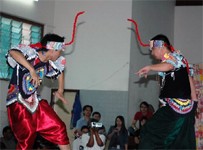
 This scene is hilarious as the chicken, while fighting, decides to shake its bottom and cluck, much to the surprise of the rooster.
