
Aliran Media Statement
Malaysians Protest Against War on Aceh by Indonesia
The Indonesian embassy refused to send any representative to meet the delegation of the NGOs and political parties and to receive the joint memorandum.
The embassy had earlier indicated that they would allow five representatives to enter the embassy and hand in the joint memorandum to the ambassador.
After much negotiation, the security guards at the front door of the embassy told the delegation that the embassy had instructed him to tell the delegation that if the delegation wanted to hand in the memorandum, they could hand it in to the guards - a suggestion the delegation rejected outright.
Instead, the delegation condemned strongly the arrogant and no-dialogue attitude of the Indonesian embassy, which it said was precisely the problem in the conflict over Aceh, where the Indonesian government has refused to engage in peaceful dialogue to resolve the problems in Aceh.
About 50 protestors turned out today with banners and placards calling for peace in Aceh, with about 30 policemen guarding the embassy and the crowd. The protest lasted for one and a half hours.
Joint Memorandam on the war in Aceh,
The situation in Aceh has deteriorated after both the Indonesian government and the GAM failed to uphold the Cessation of Hostilities Agreement (CoHA), which was signed on 9 December 2002. Under the CoHA, a committee called the Joint Security Committee (JSC) was established with representatives from GAM, the Indonesian government, the Henry Dunant Centre (HDC), and international observers from Thailand, the Philippines and Norway.
We believe this peace process and cease-fire brokered by Henry Dunant Centre (HDC) would have allowed all civilians to live their lives without fear.
However, human rights groups in Aceh have recorded numerous incidents where militiamen, said to be trained by the Indonesian military, had attacked civilians and international observers. The offices of the JSC have also been torched.
Other human rights violations include a series of rapes, murders and disappearances recently. Activists working for peace in Aceh have also been detained. On 9 May 2003, five of the negotiators from GAM were arrested as they were about to fly to the Tokyo talks.
Currently, it is estimated that around 35,000 Indonesian soldiers have been amassed in every corner of Aceh province. Rencong Sakti, the code name of this Indonesian military operation, is not just a military operation name but also a call for ethnic cleansing or genocide.
The present military offensive against GAM reminds us of the Daerah Operasi Militer (DOM) of 1987-1998, which claimed the lives of 12,000 civilians. Undoubtedly, once again, civilians will perish, with children and women being most affected. Thousands of people will be displaced from their homes and villages, and an overflow of desperate refugees from the war zone to neighboring countries in ASEAN is almost unavoidable.
Therefore, we urge the Indonesian government:
Endorsers: 1.Suara Rakyat Malaysia (SUARAM) 2.Food Not Bombs (FNB) 3.University Bangsar Utama (UBU) 4.Labour Resource Centre (LRC) 5.Persatuan Sahabat Sahabat Wanita Selangor (PSWS) 6.Network of Solidarity Collective (NOSC) 7.Pusat Komunikasi Masyarakat (KOMAS) 8.Persatuan Masyarakat Selangor dan Wilayah Persekutuan (PERMAS) 9.Save Ourselves (SOS) 10.Penang Anti-ISA Network (PAIN) 11.Malaysian Local Democratic Initiates (MALODI) 12.Parti Sosialis Malaysia (PSM) 13.Parti Keadilan Nasional (PKN) 14.Democratic Action Party (DAP) 15.Democratic Action Party Selangor Youth (DAPSY) 16.Parti Rakyat Malaysia (PRM) 17.Parti Islam Se-Malaysia (PAS) 18.SOS Selangor 19.Jawatankuasa Sokongan Peneroka Bandar 20.Aliran Kesedaran Negara (ALIRAN) 21.Women/Workers Independent Media and Training Centre (WIMTEC) 22.Gabungan Pelajar Malaysia Anti Peperangan (GEMPAR) 23.Jamaah Islah Malaysia (JIM) 24.Center for Orang Asli Concerns (COAC)
Acehnese proudly remember Sultan Iskandar Muda (ruled 1607-36), who made Aceh the most powerful state in the region. Europeans began seriously to press in during the imperialistic nineteenth century. In 1873 the Dutch launched a costly and bloody war against Aceh. Despite superior arms, it took them four decades to win effective control against Acehnese guerrilla tactics.
When Indonesia proclaimed its independence in 1945, Acehnese leaders lent crucial support. But they were disappointed that Jakarta gave Islam and themselves, far less importance than they had hoped. Aceh joined a major regional rebellion in 1953. Fighting wound down after the Acehnese won an agreement with Jakarta in 1959 that extended autonomy to Aceh.
In 1971 Mobil Oil discovered massive natural gas reserves in North Aceh. The Lhokseumawe liquid natural gas plant became the biggest in the world, suppying 30 per cent of Indonesia�s oil and gas exports. Industries mushroomed around it, and with it pollution and social disruption.
However, the Acehnese were well aware there was little in it for them. This was perhaps the main reason for the resurgence in 1989 of an Acehnese seccessionist movement that had been led for years by Hasan di Tiro from his exile in Stockholm. The military crackdown that followed left deep wounds in Acehnese society that are only now being exposed.
Source: IRIP News Service |
|||||||||||||||||||


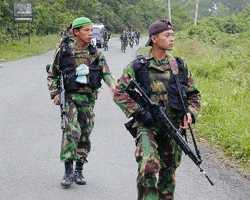 We, the undersigned non-governmental organizations, express our gravest concern and pledge our solidarity with the people of Aceh following the Indonesian government�s declaration of martial law in Aceh and its ongoing military operation against the Free Aceh Movement (GAM).