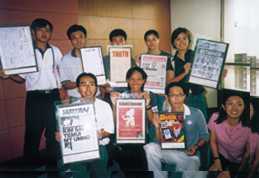
Journalists Call for Press Freedom
In a packed room, five media representatives � a freelance journalist, a senior writer with a national English daily, the editor of a Chinese language newsmagazine, an independent Malay language publisher, and a journalist from a Chinese newspaper that had been taken over - complained about the lack of media freedom.
As Big Brother videotaped and photographed them, the journalists slammed repressive laws, stifling editorial censorship, and curbs on the distribution of critical publications.
Independent publisher Ahmad Lutfi complained that several vendors selling his publications had been harassed. �Unlike others who had given Suhakam a �B� or �C� grade for its human rights work, I would give it a �D� or �E� for its efforts in promoting media freedom.�
After the dialogue session was over, journalists from independent web portal Malaysiakini held up framed covers of about a dozen publications that had been banned or shackled in the last five decades. These covers were taken from their unique Press Freedom Wall featuring the covers of such unfortunate publications.
Today, 3 May 2002, is World Press Freedom Day. We are here today, as journalists from the traditional and new media, to urge the Human Rights Commission of Malaysia to create an enabling environment for media freedom, which is consistent with provisions in the Universal Declaration of Human Rights on freedom of expression and the right to information.
On May 3, 1999, the Minister of Home Affairs was presented with a memorandum, signed by 581 reporters and editors, which called for the repeal of the Printing Presses and Publications Act. In April 2000, the minister was presented with the signatures of another 370 journalists who had endorsed the memorandum.
In the memorandum, the journalists had suggested self-regulation, in the form of an independent media council, as an alternative to the licensing provision under the Act that has resulted in self-censorship being practised in most editorial floors.
We continue to reject statutory control of the media and we urge the Commission to intervene to ensure that any media council or media complaints commission that is set up is an independent body that does not serve to further muzzle the media.
Since the handing over of the memorandum three years ago, nothing has been done to remove the obstacles that we journalists face in the performance of our duty to provide Malaysians with accurate, timely and balanced information. We attach an update on the state of the media since 1999, listing events which show that journalism in Malaysia is still under threat.
Also, while journalists and editors in the licensed media are still forced to worry about the possibility of losing their publishing permit, those who report for the new media have been barred from attending many official functions on the grounds that they have not been accredited by the Information Ministry.
In the interests of building an informed democracy, we urge the Commission to recommend to the Government to repeal all laws, rules and regulations which restrict freedom of expression and the right to information, and that a Freedom of Information Act be put in place.
Inisiatif Wartawan
Endorsed by:
Journalists ought not to stand outside the closed doors of the powerful waiting to be lied to. They are not functionaries, and they should not be charlatans: �your sham impartialists�, as Robert Louis Stevenson wrote, �wolves in sheep�s clothing, simpering loyally as they suppress�. They ought to be sceptical about the assumed and the acceptable, especially the legitimate and the respectable. (�Never believe anything�, said Claud Cockburn, �until it�s officially denied.�) Their job is not to stand idly by, but to speak for �the true witnesses, those in full possession of the terrible truth�, as Primo Levi described the victims of Nazism. At the least they ought to be the natural enemies of the authoritarianism that Rupert Murdoch says �can work�.
John Pilger
Now tell us what you think. E-mail us.
|
|||||||||||||||||||