
|
|||||||||||||||
|
ENVIRONMENT
Earth: The final frontier for human rights (Part II) The right to a �habitable environment�, once classified as an individual right, is now more relevant as a collective human right: the right to exist.
by Angeline Loh
Part II follows up the topic with discussion of the Comprehensive Nuclear Test Ban Treaty and the effects of the proliferation of nuclear armaments and weapons testing. We also look at environmental damage due to war and international investment trade, which facilitates industrialization and hence development in developing countries. Tied in with this is the international debt problem faced by impoverished countries. The final paragraphs clarify the situation humankind faces and the increasing erosion of the basic right to life as a collective right and not solely an individual one as traditionally accepted in international human rights law. The Comprehensive Nuclear Test Ban Treaty (CTBT) This treaty is another cornerstone in the struggle for the maintenance of international security as well as global environmental safety. The Treaty bans �weapons test explosions in the atmosphere, outer space, at sea, in Antarctica, or in any circumstances where radioactive debris spreads beyond the territory of the testing state�. The consequences of any fallout or radioactive pollution are dire, as has been proven by the incidents of nuclear explosions in the past. One of the most horrifying wartime catastrophies was the dropping of atomic bombs on Hiroshima and Nagasaki in Japan, ending World War II in Asia. In peacetime, we witnessed the Chernobyl disaster in the former Soviet Union, where radioactive pollution spread to parts of Europe and Scandinavia. Nonetheless, the 1996 Treaty outlaws all nuclear weapons test explosions. At the moment, world nuclear powers and nuclear aspirants (countries aspiring to become nuclear powers) have assented to a �moratorium�. This voluntary ban on nuclear bomb testing lacks the permanent legally binding effect of the Comprehensive Nuclear Test Ban Treaty (CTBT) - if it comes into force, that is. For the Treaty to be enforced, the 44 states with nuclear weapons production capability must ratify it, although 172 nations have signed it and 116 have ratified it. Of the crucial 44, thirty-two have ratified it; the 12 that still have not done so are the US, China, North Korea, Israel, India, Pakistan, Iran, Egypt, Colombia, Vietnam, Indonesia and Congo. Nuclear weapons testing by these countries continues in disregard of UN investigations and negotiations to terminate such activities. Despite the call by 42 states signatories of the Treaty (amongst them are close allies of the US) urging the remaining non-signatory nations to sign and ratify the Treaty, the United States maintains its uncompromising stance, opposing the pact although its claimed there were no plans to resume nuclear testing. �The longer its entry into force is delayed, the more likely that nuclear testing will resume,� said UN Secretary General Kofi Annan. �Were this to happen, it would be a major setback in nonproliferation and nuclear disarmament efforts; in the era in which we live, we cannot afford such a set back.� The joint ministerial statement emphasised that the CTBT was vital to nuclear non-proliferation and disarmament: �The CTBT will make an important contribution towards preventing the proliferation of materials, technologies and knowledge that can be used for nuclear weapons, one of the most important challenges the world is facing today.� It is not only the threat of nuclear war that gives rise to this urgency but more the aftermath of any nuclear explosion that endangers life and the environment. Nuclear fallout does not disperse overnight; it can take centuries. The Japanese were �painfully aware of the dangers of nuclear weapons� having been the �the only nation that suffered� the devastation of atomic bombs.� There are innumerable testimonies witnessing to the aftermath of the devastation and the effects of intense radiation by several generations of victims� descendants, those whose forbears were the ill-fated residents of Hiroshima and Nagasaki. As the usage of nuclear weapons has become more popular in this age where wars break out all over the world and keep raging indefinitely, their contribution, along with that of conventional weaponry, to the destruction of human life and the environment cannot be overlooked. Armed conflict and other sources of pollution Armed conflict is in itself a danger to human life. The process of armed conflict involves immediate damage as well as latent damage to the environment. For instance, land mines laid during the 20th century wars waged in Indo-China still pose a danger to rural folk living and working in the country-side. Neither the governments of these nations nor international land-mine disposal units have managed to unearth and dispose of all these mines buried just below soil surfaces or hidden in undergrowth. Consequently, many tragic accidents have occurred when unwary adults, children or animals happen to trod unwittingly on these mines. The resulting explosions may also deforest an area. The US bombing and spraying of defoliant during the war in Vietnam in the 1970s left large craters in the ground and huge areas poisoned and bare of vegetation. The only evidence of lush jungle that existed before that devastation took place were blackened and broken trunks of once majestic trees. What was even more vicious was the use of Agent Orange, which caused excruciating human suffering besides environmental contamination. A similar tactic was used by Indonesian forces in East Timor during the invasion and occupation of that land for more than 20 years before its recent independence. Much of the land was deforested en masse in attempts to root out guerilla forces. Deforestation results in barren land when fertile topsoil is washed away by torrential rains, erosion and landslides in hilly areas. Loss of greenery and vegetation is loss of absorption of carbon dioxide (CO2), which is the main greenhouse gas that causes climate change. When land is barren, food production is difficult or impossible, leading to famine. Water sources are also reduced as evaporation is accelerated without ground cover of any kind to hinder water loss; thus, desertification begins. Many of the war-torn countries in Africa bear witness to these effects of ecological imbalance over the past decades. When oil wells in Kuwait were set alight in the wake of the Iraqi pullout that ended Saddam Hussein�s invasion and occupation of Kuwait, it took months for these oil fires to cease burning. Over that period, enormous towers of billowing black smoke rose to pollute the air space in that region of the Middle-east. This probably added to the increasing emissions of green house gases from industrialized countries. The US-led war on terrorism has made matters worse with the destruction of Iraq and the insurgency that continues to plague this �liberated� country. With the continuing loss of human life, increased poverty, social and political disorder, and attacks on oil installations, there seems no hope of preventing catastrophy. The race to industrialise Although the Kyoto Treaty may cause developed countries to find alternative means to maintain economic growth, developing countries should not see themselves exempt from reviewing their choices of development programmes and technologies adopted to drive these programmes. Multilateral and bilateral trade and investment agreements seem not to be completely controlled by the governments of sovereign states. Developing countries frequently seem under pressure to keep the favour and appease developed countries upon whose aid they depend. Ironically, a current report by Oxfam on aid from developed nations revealed that aid funds had been drastically reduced since 1960. In addition, the international debt problem remains unresolved, increasing poverty in poor indebted countries and allowing the international economy to be dominated by rich developed and developing nations. In the majority of ASEAN countries, foreign investment plays a leading role in economic development. Without foreign investment, these �tigers� would perhaps still be �cubs�. Malaysia may boast of its increasing industrialisation and widening opportunities for investment within and without the country. While these may be viewed positively, we should, however, begin to question where this �development� is heading. If hegemony and protectionism remain characteristic in the acquisition of wealth,and governments neglect to reflect on the damage done by so-called progressive development and industrialization, the Kyoto Agreement�s aim of slowing damage to the global environment would be to no avail. When developing countries become developed countries, history will repeat itself. By then it may be too late to turn the clock back. To sum up There is much to reflect on. What has the discussion about the environment got to do with basic human rights? Everything. Human beings are now an endangered species. The human right to a �clean environment� or rather a �habitable environment�, which was classified as an individual right, appears to have become more relevant as a collective human right- the right of peoples to exist. The right to life is defined and enshrined in the Universal Declaration of Human Rights and other international treaties such as Article 6(1) of the International Covenant on Civil and Political Rights (� No one shall arbitrarily be deprived of his life.�) Critics may argue that this right can only be relevant to the individual in the context of �obvious� threats to her/his life. But environmental devastation - which causes ecological imbalance and other catastrophies that endanger human life - is similarly an arbitrary death sentence on innocent people. International law has to be updated to cope with fast-changing circumstances. The international community needs to adopt a more responsible and pluralistic attitude towards each inter-dependent society on earth, regardless of ethnicity and minority in numbers. The planet is home to humankind and is not the colony of any one sovereign state. It is our final frontier. Please support our work by buying a copy of our print publication, Aliran Monthly, from your nearest news-stand. Better still take out a subscription now. If you prefer to read our web-based edition, please support our work and make a donation. Now tell us what you think in fewer than 250 words. Your comments may be published in the Letters section of our print magazine, Aliran Monthly. | |||||||||||||||

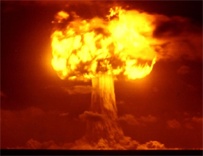
 It is not only the threat of nuclear war that gives rise to this urgency but more the aftermath of any nuclear explosion that endangers life and the environment.
