
|
|||||||||||||||
|
INTER-RELIGIOUS DIALOGUE
Trust, understanding needed for inter-religious council We should not try to run before we can walk
by K Haridas
As one who was involved from the early meetings relating to the formation of the Inter-Religious Council I would like to respond to certain misconceptions that Johan expresses which need clarification. We know that, as early as the late 1970s, Dr.Chandra Muzaffar proposed the setting up of an Inter-Religious Council. (IRC) Over the years, he has repeated this call. At a seminar organised by the Bar Council in December 2000 on �Freedom of Religion�, he reviewed this idea in a more detailed manner. The following year, 2001, then Bar Council president Sulaiman Abdullah set up a committee to work towards the establishment of an IRC. A number of non-governmental organisations (NGOs), including the International Movement for a Just World (JUST), became involved in this initiative. Perceptions of antagonism During the latter part of that year, a number of Muslim members of the steering committee perceived that some steering committee members of the Bar Council and a few others saw the IRC as a forum for articulating non-Muslim religious grievances. Some committee members seemed more concerned about highlighting their grievances than being sensitive about how this affected other groups. A memorandum tabled by the Malaysian Consultative Committee for Buddhism, Christianity, Hinduism and Sikhism (MCCBCHS) did not help the process. Further, discussions addressing topical issues such as apostasy and child custody cases were red herrings that detracted from the main agenda of setting up the IRC. Expressions and feelings on these issues did not contribute to the search for a common response towards the idea of an IRC. Instead, these created a negative perception in some quarters on the credibility of those leading the committee Some Muslim committee members perceived such expressions as antagonistic towards Islam. They then decided not to participate in the deliberations of the committee. No meetings were then held until the last quarter of 2002. Then Bar Council president Mah Weng Kwai attempted to revive the idea. Raja Aziz Addruse then met with Chandra persuading him to get involved and to chair the steering committee. Together, they then met with the Muslim committee members who left the steering committee and others. In January 2003, several of them agreed to rejoin the committee based on the agreement reached between them. Workshop postponed It was then agreed that a workshop be held to discuss issues within a larger forum. This was scheduled for February 2003 and was to be initiated by civil society rather than the Bar Council. The Bar would still remain a member of the steering committee. Thus, some members of the Bar in the Committee would have to step down. The objective of the workshop was to explore the possibility of setting up the IRC. If formed, this body would have no powers of adjudication. It would concentrate on promoting understanding, confidence and trust building between the different religious communities However, as the keynote speaker could not come for several reasons, the workshop was postponed. In March 2003, the members of the Bar Committee who were required to step down and others objected to the agreement reached between Raja Aziz Addruse and Dr Chandra Muzaffar on the one hand and Muslim members who had earlier left the steering committee on the other. They argued that the Bar should continue to helm this initiative rather than civil society groups. As a result of this, the Muslim groups rescinded their earlier decision to rejoin the committee. Chandra then met with newly elected Bar Council president Kuthubul Zaman Bukhary to persuade him to postpone the workshop scheduled for 17-18 May. This was to enable more negotiations to be conducted between the steering committee and Muslim individuals and groups. Despite Chandra�s letters to him and plea, the Bar decided to proceed with the workshop. Since May 2003, JUST has not been involved with the IRC effort. JUST, however, continues to be committed to inter-faith dialogues at the national and inter-nations levels and has initiated and participated in such events. Johan Abdullah must realise that progressive groups like ABIM and JUST recognise that it is futile to proceed if the effort does not command legitimacy in the eyes of the Muslim community in particular and the Malaysian public in general. Inclusivity requires openness We should not try to run before we can walk. Inter-faith and inter-religious matters are sensitive in nature. A level of understanding and trust must exist before hard issues are handled. An Inter-Religious Council would have been a good beginning leading eventually to the formation of an Inter-Religious Commission. Perceptions are real and all who hold differing views believe in their realities. Sometimes the medium itself has to change. The Bar Council should have left this to civil society. One needs more than adversarial skills, arguments and facts to manage the process. There is much goodwill and open-mindedness in Malaysia. Perceptions, however, define realities. On issues relating to religion and faith, credibility and trust have to be established. A sense of maturity and understanding must prevail. I may not agree with how I am being perceived but, if this impacts the process, then in the larger interest I should step aside. People come from their own level of understanding and much accommodation is called for if the process is to succeed. The Bar must be credited for taking action on this initiative. At the same time representatives of the Bar should have had the humility to pass this on to civil society and not question why they were so perceived. So long as we are unable to bring into the dialogue process the Muslim community - be they mainstream, moderate or extreme - we should admit that more work needs to be done. That is why an inter-religious council should be a forerunner to the creation of an Inter Faith Commission. What has happened following their last seminar was the development of the idea into an Inter Faith Commission. One can appreciate this for it brings onto the table the strengths of the Bar Council. If there is inadequate goodwill, however, such laws and regulations will remain at best good formulations If the spirit of inclusivity dictates, then a good representative majority would support such a laudable objective. Inclusivity, however, requires a language of openness, a willingness to listen, moderation and, if need be, the readiness to step aside for the larger good. This is yet another good example of good intentions that have run aground, contributing thereby to a further polarisation of views on this issue. Please support our work by buying a copy of our print publication, Aliran Monthly, from your nearest news-stand. Better still take out a subscription now. If you prefer to read our web-based edition, please support our work and make a donation. Now tell us what you think in fewer than 250 words. Your comments may be published in the Letters section of our print magazine, Aliran Monthly. | |||||||||||||||

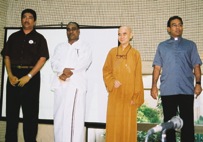
 On issues relating to religion and faith, credibility and trust have to be established. A sense of maturity and understanding must prevail.
